
The first signs come early. A card lands on the mat in November with both your names on the envelope. Someone in the family group asks, carefully, what everyone is doing this year. The supermarket puts out the mince pies she always bought too many of. The first Christmas without a loved one begins weeks before the day, and much of it arrives as small decisions that nobody wants to be the one to make.
This page is for the household making them. It covers where to spend the day, how to sign the cards, what to say at the table, how to help the children, and a letter to the person missing them most. Further down are words for friends writing to someone facing it, and how other traditions keep a first New Year, Tết or Eid in mourning. The families in the examples are invented, and every script is there to be changed.
Why the First Christmas Without a Loved One Feels Different
The first year after a death is a calendar of firsts: the first birthday without them, the first time the clocks change and nobody resets the one in the car. For the anniversary of the death, see what to say on a death anniversary. Christmas is different from the other firsts because it runs on repetition. The same food, the same people, the same jobs done by the same hands every year, so that nobody has to think about them. This year someone has to think about every one of them. Who carves. Who writes the cards. Who hides the presents, and who rings Auntie Jo. Each question points at the same empty place.
Many people find the weeks before harder than the day itself. A bereavement coordinator at Marie Curie writes that the people she has supported tend to say exactly that afterwards. If November is already heavy, that is not a forecast for the 25th.
Getting through the first Christmas without a loved one starts with permission to do less. Fewer cards or none, a smaller meal, a different house, a walk instead of the film. If the death was only weeks ago, do what has to be done and let someone else decide the rest. Some families and faiths keep mourning customs of their own, described further down.
Three Decisions to Make Before the Day
Three decisions are worth making in November, while there is still time to talk them through.
Where. The same house keeps the familiar and the gap together: their chair, their mug, their way of doing the potatoes. Someone else's house spreads the work and changes the room. Going away, to a rented cottage or a hotel lunch, takes everyone out of the old script. Some families find that is exactly what they need, and others miss the house by the afternoon. Whatever you choose, choose it for this year only, and say so.
What to keep, pause and try. Take a sheet of paper and draw three columns. This is how one invented family filled theirs in, the first Christmas after Ray, a father and grandfather, died in the spring.
| Keep | Pause this year | Try |
|---|---|---|
| Christmas Eve at his sister Lyn's | The Boxing Day party for twenty | Lunch in the kitchen, where the room feels smaller |
| Stockings for the grandchildren | The quiz Ray set every year | One story each before pudding |
| The walk to the bridge after lunch | The long table in the dining room | Ray's records on after lunch |
| The carol service on the 23rd | The round robin letter | A new pudding, so nobody compares |
Put the sheet somewhere you will find it next November, when the columns may look different.
Whether there will be a moment. Decide whether someone will say their name out loud at a set point in the day, and who that will be. Left to chance, often nobody does, and everyone spends the meal thinking about them in silence. A planned moment, even thirty seconds long, gives the table permission, and an end.
Then tell everyone in one message, before anyone makes other plans. Something like this:
Hi all. I've been thinking about Christmas without Dad, and here's an idea. Please say if it doesn't work for you. Lunch at ours, smaller than usual, and no party on Boxing Day this year. Before pudding I'd like us each to tell one story about him. Nobody has to. And the kids get to choose one thing we do for Grandad.
Love, Anna
The last line is deliberate. The children's bereavement charity Winston's Wish suggests asking children how they want to mark Christmas, and giving them a say in the plan before it is fixed.
How to Sign Christmas Cards After a Death in the Family
Start with whether to send them at all. The same Marie Curie coordinator writes that, in her experience, nobody expects a grieving family to send cards if they do not want to. If you skip them, ask one person, a sister or a close friend, to let the wider circle know, so the silence is not misread. A short note in January can do the work of fifty cards.
If you do send them, the hardest part is often the signature. In the first Christmas without your husband or wife, it can be the moment the loss becomes real on paper: one name where there were always two. The table goes situation by situation, with a line to add if you want one.
| Situation | How to sign | What to write, if anything |
|---|---|---|
| Writing as a widow or widower | Your own name: "Love from Margaret" | "Joe always loved your card, so I wanted you to have one from me this year." |
| A family after a parent died | Everyone still at home: "Love from Sam, Priya, Leo and Kit" | "Our first Christmas without Mum. We are looking after each other." |
| Adult children writing to a parent's friends | "With love from Ellen and David, Barbara's children" | "Mum kept your card on the mantelpiece every year, so we wanted you to hear from us." |
| Keeping their name in the card | "Love from Margaret, remembering Joe" | Nothing more is needed. |
| People who may not have heard | Your name as usual | A slip inside: "In case you haven't heard, Joe died in June. Thank you for all the years of cards." |
| Nothing sent before Christmas | A note or email in January, in your own name | "We didn't manage cards this year. Thank you for yours. We read every one." |
| A card that still came to both of you | Reply in your own name | "Thank you for your card. I'm sorry to tell you that Joe died in June. He always looked forward to your news." |
| A card to colleagues | Your name as usual | "Thank you for carrying some of my load this year. It made a difference." |
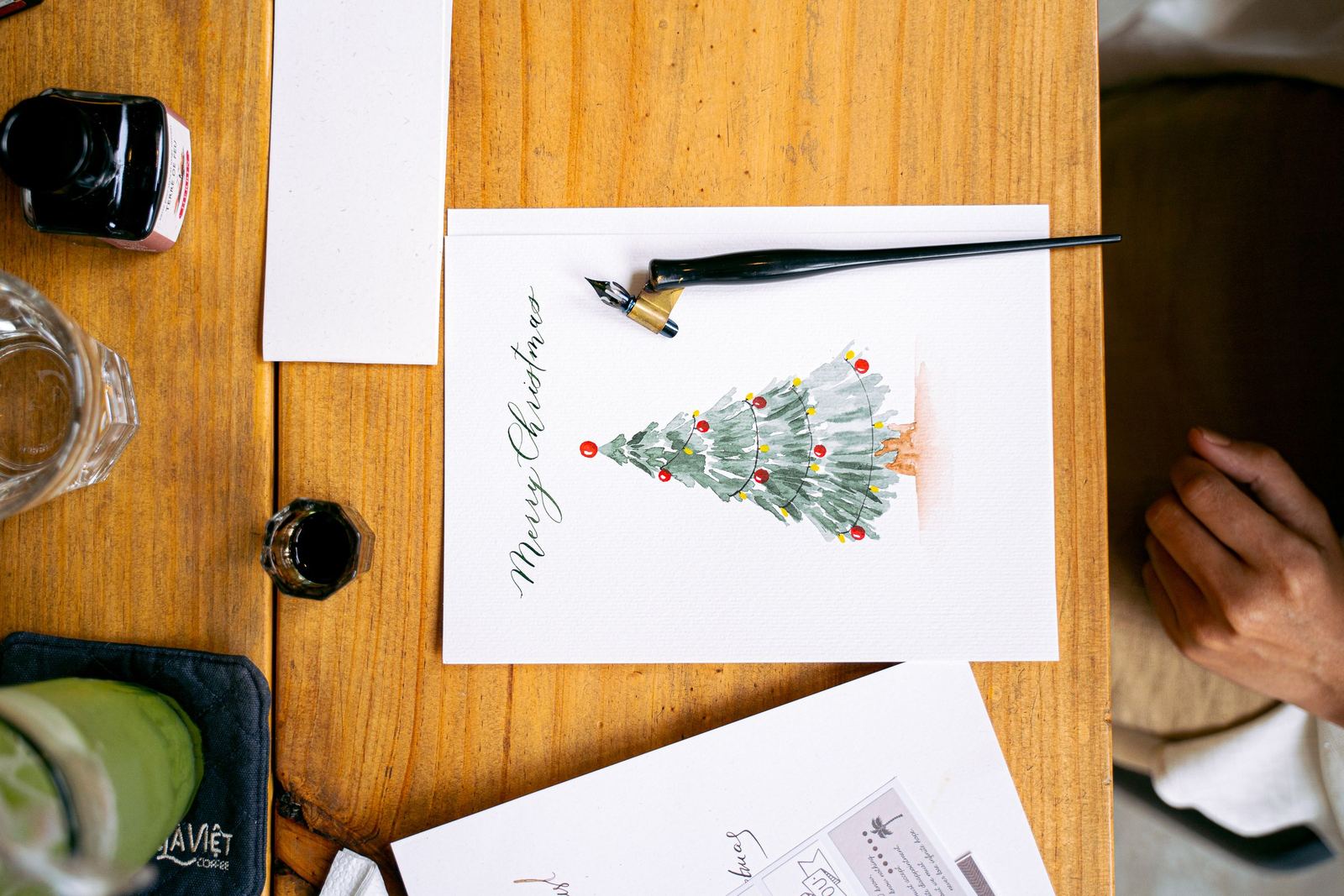
Should you still sign their name? The kindest default is to sign only the people who are still here. A card signed by someone who has died can startle the person who opens it, or leave them unsure whether they missed the news. Adding "remembering Joe" after your own name keeps him in the card without that confusion. If a small child wants to add Grandpa in their own handwriting, let them: that one is theirs to decide.
What to Say at the Table: A Toast and a Few Words
Pick the moment before the day, so nobody has to judge it in the middle of a meal. Before the food is served suits a family that wants it said and then wants to eat. Before pudding suits a table that needs to settle first. Or tie it to a candle: when it is lit, someone speaks.
The speaker does not have to be the eldest, or the person who was closest. It should be someone who wants to and thinks they can get through it, with a second person ready to finish it if they cannot. A grandchild of twelve can do it well. A Christmas toast to remember a loved one needs only thirty seconds. Three scripts follow.
A 30-second toast.
Before we eat, I want to say one thing. This is our first Christmas without Dad, and he would hate us being quiet about it. He'd have been in this kitchen since seven, telling everyone the potatoes were nearly done when they weren't. We miss him at this table, and we're glad to be at it together. So, Dad, this one's for you. Happy Christmas, everyone.
A one-minute opener for one story each.
Before pudding, I'd like to try something Mum would have liked, because she never let a meal end without a story. Let's go round the table and each tell one short story about her. It can be funny. It can be tiny: something she said, something she burned, the time she drove us all to the wrong church for Aunt Rose's wedding. If you'd rather pass, say pass. You can tell yours later, or not at all. I'll go first, so you have something to beat. The year I turned ten, she...
For a family that says grace. Say your grace as you always do, in the words your family knows, and add one sentence of your own at the end: "And we remember Ray, who sat with us every Christmas, and whom we miss today." Then begin. The prayer itself belongs to your own tradition.
When someone cries. Nothing needs fixing. Wait. Pass the tissues. Say "Take your time," or "That's why we're doing this," and let the pause be a pause. Do not rush to change the subject, or turn the whole table toward the person crying. When they nod, carry on, or let someone else take the next story.
A line a child can say. Give a child one sentence with a gap in it, and let them practise it with you once beforehand: "My favourite thing about Grandad was..." Whatever they put in the gap is enough.
The empty chair. Some families keep an empty chair at Christmas, set their place, or put a candle where they sat. Others find it hard to sit beside for two hours and quietly move the seats around. Either is fine, and neither is a rule. Ask the person who would be sitting next to it.
Small Ways to Keep Them in the Day
The ways of honouring a loved one at Christmas that families remember are rarely decorations. They are things done the way the person did them, with their name said out loud:
- Cook their recipe, and say whose it is. Make Nan's trifle from her recipe card, the one with the custard stain, and prop the card up while you cook. When it reaches the table, say "This is Nan's."
- Play their music. The record they put on every Christmas Eve, or the album that lived in the car. Let it play while the food cooks rather than making a ceremony of it.
- Light one candle. At a moment you have agreed, lit by whoever wants to, with a sentence or with nothing at all.
- Keep a story jar. Leave a jar and a pile of slips by the door. Everyone who arrives writes down one memory, and one line is enough. After the meal someone reads a few aloud, and the rest are kept for another day.
- Carry on their giving. If he always bought the neighbours' children a selection box, or she gave to the food bank every December, do it again this year in their name.
- Take their walk. The Boxing Day walk to the reservoir, the drive to see the lights in town, or a visit to the grave if your family does that.

One or two of these is plenty. A day packed with remembrance can be as tiring as a day with none.
Children at the First Christmas After a Death
Tell children the plan before the day: what will be the same, and what will be different. Use plain words. Marie Curie and the children's charity Barnardo's both advise using the words "died" or "dead", rather than saying someone is lost, gone away or asleep. A short version for a child of six or seven:
Grandpa died in March, so this Christmas will feel different. We are still having lunch at home, and you will still have your stocking. Some of us might be sad on the day, and that's all right. You can talk about Grandpa whenever you want, and you can be happy, too.
Ask each child how they would like to remember the person, and let them choose one thing: hang the decoration they made together, pick a song, draw a picture for the table, or write a card to Grandpa. If they want to write to him, our guide to writing a letter to someone who died has ideas you can adapt for a child.
Keep as much of the ordinary as you can. Barnardo's advises a consistent routine for young children, and at Christmas that can also mean the film, the stocking, and the breakfast that is always the same. A child who knows what comes next has one less thing to worry about.
And if you cry in front of them, that is all right. Marie Curie's advice for families says so. Tell them what it is ("I'm crying because I miss Grandpa. I'll be all right in a minute.") and let them see you carry on. A child who watches an adult be sad and then pass the potatoes has seen that sadness and Christmas can sit at the same table.
A Letter to the Person Missing Them Most
Often one person in a family is carrying more than the rest: a widowed parent, the brother who did the caring, the sister who was there every day at the end. At Christmas everyone watches them and nobody quite knows what to say, and the cards they get say "thinking of you" in forty slightly different ways. A letter can say the specific thing, and they can read it alone, in their own time, without an audience.
A letter like this makes four moves:
- Name the person who died. Early, and plainly. It is often the word nobody else will say.
- One memory that includes the reader. Not a memory of the person alone, but one where the reader was there too, so the letter is about both of them.
- What you see them carrying. The jobs they took on, the calls they made, the small brave things nobody thanked them for. Name them.
- One plan for the new year together. Something with a month and a place, so the new year has something in it.
Here is a letter from an adult daughter to her father at the first Christmas without her mother.
Dear Dad,
This is our first Christmas without Mum, and I didn't want the day to go by with all of us talking about the gravy and nobody saying her name. So: Helen. Mum. I miss her every day, and I know you miss her more.
Do you remember the Christmas I was twelve, when the oven broke at ten in the morning? Mum sat on the kitchen floor and laughed until she cried, and you carried the turkey next door to Pat's in your slippers, in the rain. We ate at four. She told that story every year after, and every year you said it was raining harder than she remembered.
I've watched you this year. You wrote back to every card by hand, all ninety of them. You sorted her clothes so I wouldn't have to, and kept back the green coat because you knew I'd want it. You have done all of it quietly, and I'm not sure anyone has said thank you. Thank you.
You don't have to be all right on Christmas Day. If you need ten minutes in the garden, go. Nobody will mind, least of all me.
In March, when the days are longer, I'd like us to take the train to the coast, just the two of us, and walk the pier the way you and Mum did every spring. I've looked up the trains. I'll book them if you say yes.
I love you, Dad.
Kate
The third paragraph is the one most people leave out: it tells him what she has seen him do, in detail, and thanks him for it. And the ending has the trains already looked up, so all it asks of him is a yes.
Between brothers and sisters, shorter is usually better:
Tom,
First Christmas without Dad. I keep thinking about the year we stayed up to catch him filling the stockings and fell asleep on the landing, and he stepped over both of us. You were the one who stayed close this year, and drove up every weekend when I couldn't. I saw it. Let's do the January walk again, just us two, even if it rains.
Love, Ellie
Paper and email both work. Paper can be left on a pillow on Christmas Eve, and email reaches a brother on the other side of the world. If the person you most want to write to this year is your own child, our Christmas letter to your children has six example letters, for children from nine months old to thirty-four.
Mourning Customs at Christmas, New Year and Eid
Many traditions keep a first holiday season after a death in their own way. What follows describes what many families do, not what any family must, and customs differ from one household to the next, so ask the elders in your family.
Japan. Many families send a short mourning postcard (喪中はがき, mochū hagaki) in November or early December, so friends know not to send New Year cards. When the death came in December, many send a winter greeting (寒中見舞い, kanchū mimai) instead. It goes out after the New Year season ends, about 7 January in many regions and 15 January in some, and before about 4 February. Many families keep a quiet New Year, with no decorations, no "Happy New Year" greeting, and a visit to the grave. Customs differ by household, region and Buddhist school.
Chinese families at Spring Festival (Chinese New Year). Many families do not put up red couplets at the first Spring Festival after a death, and some use paper of another colour. The colours, and the number of years the custom lasts, differ from place to place. Spring Festival falls on 6 February 2027.
Vietnamese families at Tết. Many families in mourning stay home at Tết rather than making the usual visits, and neighbours come to them instead. Many also avoid being the first visitor to another home in the new year. Tết falls on 6 February 2027.
Korean families at Seollal. Seollal falls on 7 February 2027, and how a household in mourning keeps the holiday rites differs from home to home.
Orthodox families. Christmas falls on 7 January in the Russian, Serbian and Georgian churches, and on 25 December in most Greek Orthodox churches and in the Romanian and Bulgarian churches. Since 2023 Ukraine's official Christmas has been 25 December, though some Orthodox families still keep 7 January. Many Orthodox families keep the first forty days after a death quietly, and some keep a quiet New Year table if it falls inside them. Priests answering readers usually call this a family custom rather than a church rule, so ask your priest.
Muslim families at the first Ramadan and Eid. Ramadan begins around 8 February 2027, and Eid al-Fitr falls around 9 or 10 March, depending on where you live: Turkey's Diyanet calendar gives 9 March. Eid al-Adha is around 16 May. Many Muslim families visit graves on the eve of Eid or after the Eid prayer. No day is required, and scholars and families differ on whether Eid is the time for it.
What to Write to Someone Facing a First Christmas Without a Loved One
If you are writing to a friend this year rather than receiving the cards, a Christmas message for someone grieving does not need to be clever. Hospice UK says that saying something is better than saying nothing, and Sue Ryder suggests a blank card, a concrete offer, and telling them they do not need to reply. Say the name of the person who died, go easy on "Merry", which can sting on its own, and make one offer with a day attached.
Send it in time. A card should arrive before Christmas, and a message is kindest on Christmas Eve or that morning, not a few days after.
- Instead of "Thinking of you at this difficult time," try "Thinking of you, and of Mark, this Christmas."
- Instead of "Merry Christmas!", try "With love at Christmas," or "Sending love as the year ends."
- Instead of "Let me know if you need anything," try "I'm bringing a pie round on the 27th. I'll stay ten minutes or the whole afternoon, whichever you'd like."
- Instead of "I can't imagine how you feel," try "I've been thinking about Mark's terrible Christmas jumpers all week."
Six lines to start from, with your own detail in the brackets:
- To a widowed friend: "This is your first Christmas without [name], and we'll miss [him or her] at ours too. I'll come over on [day] with [something you always bring]."
- To a colleague: "Wishing you and your family a gentle Christmas. Nothing at work needs you until you're ready, and there's no need to reply."
- To a friend far away: "I wish I could be at your table this year. I'll ring on [day] at [time], and we can talk about [name], or about nothing at all."
- To a neighbour: "We'll miss seeing [name] [putting up the lights] this Christmas. I'm leaving a plate of [food] in your porch on [day]. No need to come to the door."
- To a brother or sister: "Save me the seat next to you at lunch. If it gets too much, we'll do the washing up together and talk about [name] in the kitchen. I'm here, whenever, for all of it."
- To a mother whose child has died: "I'm thinking of [child's name] this Christmas, and of you. I still remember [one small detail about them]. I'll say [his or her] name whenever you want to hear it."
What not to write. Leave out "at least" in all its forms (at least she isn't in pain, at least you had so many years), and "a better place", which tells a grieving person how to feel. A card does not have to make them feel better. It only has to tell them that neither they nor the person they miss has been forgotten.
Keeping the Stories Told That Night
If your family tries the one-story-each round, someone will tell a story the rest of you have never heard, and it is worth keeping. Before the round starts, one person can ask out loud whether everyone is happy for it to be recorded on a phone, and record the asking. Anyone can pass or ask for their story to be left out, and the rules on recording people differ by country and state, so check where you are. The practical side is in how to record your voice for your family. And if the only recording of the person who died is an old voicemail, save the voicemail before anyone closes the phone line.
Afterwards, the stories can become a letter. A letter on Goodbye App carries text and one voice recording. Choose the one story that matters most, or trim the evening's recording into a single file, and type the others into the letter. Send it by email to the family for next Christmas, or for the anniversary of the death. You pick the day and the hour it goes out, on your own clock, up to 30 years ahead. If some of the family live abroad, check what time that will be for them. It stays private until it is sent, and it is free, in 15 languages, on the web and Android.
Each letter goes out once, so the Christmas after needs another one, written for that year. An optional inactivity release, off unless you switch it on, can send letters earlier if your account goes quiet for a period you set between 3 and 45 days. A photo from the evening goes in a separate scheduled post, which can be private to the people you choose.
Some of the best stories will come from the oldest people at the table, and a full table is not the place to ask them for more. Our questions to ask your parents are for a conversation the next day, one to one, on a walk or in the kitchen.
When It Is More Than a Hard Day
Grief at Christmas is not a sign that something has gone wrong. Feeling flat, tearful, angry or numb through December is part of grieving for a great many people, and the NHS notes that for most people grief becomes less intense over time.
Talk to your doctor or a bereavement service where you live if low mood has lasted more than a couple of weeks, or if the things you are trying are not helping. If it is someone else at the table you are worried about, find a quiet moment to say so to them gently, and suggest the same. If you think someone may be in danger, do not wait for the day to be over: contact your local emergency services straight away. If you are not sure what support exists near you, your doctor, or the hospital or hospice that cared for the person who died, can often point you to it. You do not have to wait until January to ask.
Common Questions
Should we still celebrate Christmas the first year? If you want to. Some families keep every tradition because the routine holds them up. Others do almost nothing, or go away. Any of these is normal, so decide for this year only.
Is it all right not to send Christmas cards after a death? Yes. Nobody expects cards in the first year. Ask one person to tell the wider circle, and send a short note in January if you want to.
How do I sign Christmas cards after my husband or wife died? In your own name only, for example "Love from Margaret". If you want them in the card, add "remembering" and their name after yours, rather than signing for them.
What do I say to a friend at their first Christmas without their mum? Mention her, and make one offer with a day attached: "Your mum's shortbread has been on my mind all week, and so have you. Can I take you for a walk on the 28th?" Then tell them they do not need to reply.
Can I put their photo on the card? On a printed card, yes, if it feels right to you. A family photo with them in it, from a good day, is often gentler than a portrait on its own, which can catch someone off guard in a pile of cheerful cards.
What if the family disagrees about the plan? Ask each person for the one thing that matters most to them, and build the day around those. A plan for this year only is easier to agree to, and a day can be split: the morning one way, the evening another.
Is the second Christmas sometimes harder? Many people say so. Some describe the first year as cushioned by everyone else's attention, and the second as quieter, with fewer cards and fewer people asking. Plan it as carefully as the first.
Is the first New Year after a loss harder than Christmas? For many bereaved people, yes. Plan the evening ahead: who you will be with, whether you will stay up for midnight, and a way to leave early. Going to bed at ten is a perfectly good way to see in a year.
If you are reading this because you are thinking about ending your life, please talk to someone today. findahelpline.com lists free, confidential helplines in your country, and there is more on our suicide and self-harm page.
Every person has a legacy®
Begin


