Every December you write a few words in your children's cards, and most years they are close to the same words: love, a kiss, a name. Then one year the thought arrives: I want to write a Christmas letter to my children, a real one, and say what a card has no room for. This page is for that letter, whoever it is for: a small child who still needs it read aloud, a teenager at the end of a hard year, a grown son or daughter with a home of their own, or a grandchild.
It gives you four moves a Christmas letter can make, questions to answer before you write, and six example letters: to a six-year-old, a fifteen-year-old, a son in his thirties, a daughter far from home, a baby at their first Christmas and a grandson. The families in them are invented. The details are there to show how small and exact yours can be. At the end there are short lines for the years you only have time for a card, and a note on how a letter reaches them.
Why Write a Christmas Letter to Your Children
A card carries a line. A letter carries a year. In a card you can say that you love them. In a letter you can say what you watched them do in March, what you have noticed about the person they are becoming, and what you remember from a Christmas they were too young to keep.
December makes it easier. The year is nearly over, and most of us look back whether we mean to or not. A letter puts that looking back on paper for one person. A grown child may not have had a letter from you in years.
From 1920 to 1943, J.R.R. Tolkien wrote and illustrated letters to his children in the voice of Father Christmas. Every December, a letter with a North Pole stamp arrived for his children, in time all four of them: John, Michael, Christopher and Priscilla. The first went to his eldest son, John, and the letters became a family tradition. They were published in 1976 as The Father Christmas Letters, and are in print today as Letters from Father Christmas.
He wrote them in character, as Father Christmas, with notes from a clumsy North Polar Bear and an elf named Ilbereth. The letter on this page is the other kind: one in your own name. But his letters show what happens when a letter comes every year. For long enough, it becomes a family's record of itself.
If your family's big day is New Year, nothing here changes: a New Year letter to your children takes the same shape, so write it for the day you actually sit down together. For one-time occasions such as a wedding or a graduation, see milestone letters to your children instead.
What to Write in a Christmas Letter to Your Children
A good Christmas letter can make four moves, in roughly this order.
- A dated scene from this year. A real moment, with a place and a month if you can. Not "you worked so hard this year", but the evening you found them asleep on the sofa with their school bag still on their shoulder.
- A trait you watched grow, and the moment that proved it. Name the quality, then give the one time you saw it. The moment turns praise into evidence, and evidence is harder to wave away.
- A Christmas they were too young to keep. Tell them about one from before their memory starts: what they did, who held them, what went wrong. This is the move only a Christmas letter has, because the day comes round every year and joins this one to the first.
- One plan for next year. Something you mean to do with them, with a place or a month: the lake in June, the recipe you will finally teach them. A plan ends the letter looking forward, and it is a promise you can keep.
Aim for 200 to 400 words. That is a page or two by hand, or two to three minutes read aloud. Go shorter for a small child, whose attention will run out before a long page does, and longer for a grown child, who will read it alone and probably more than once.
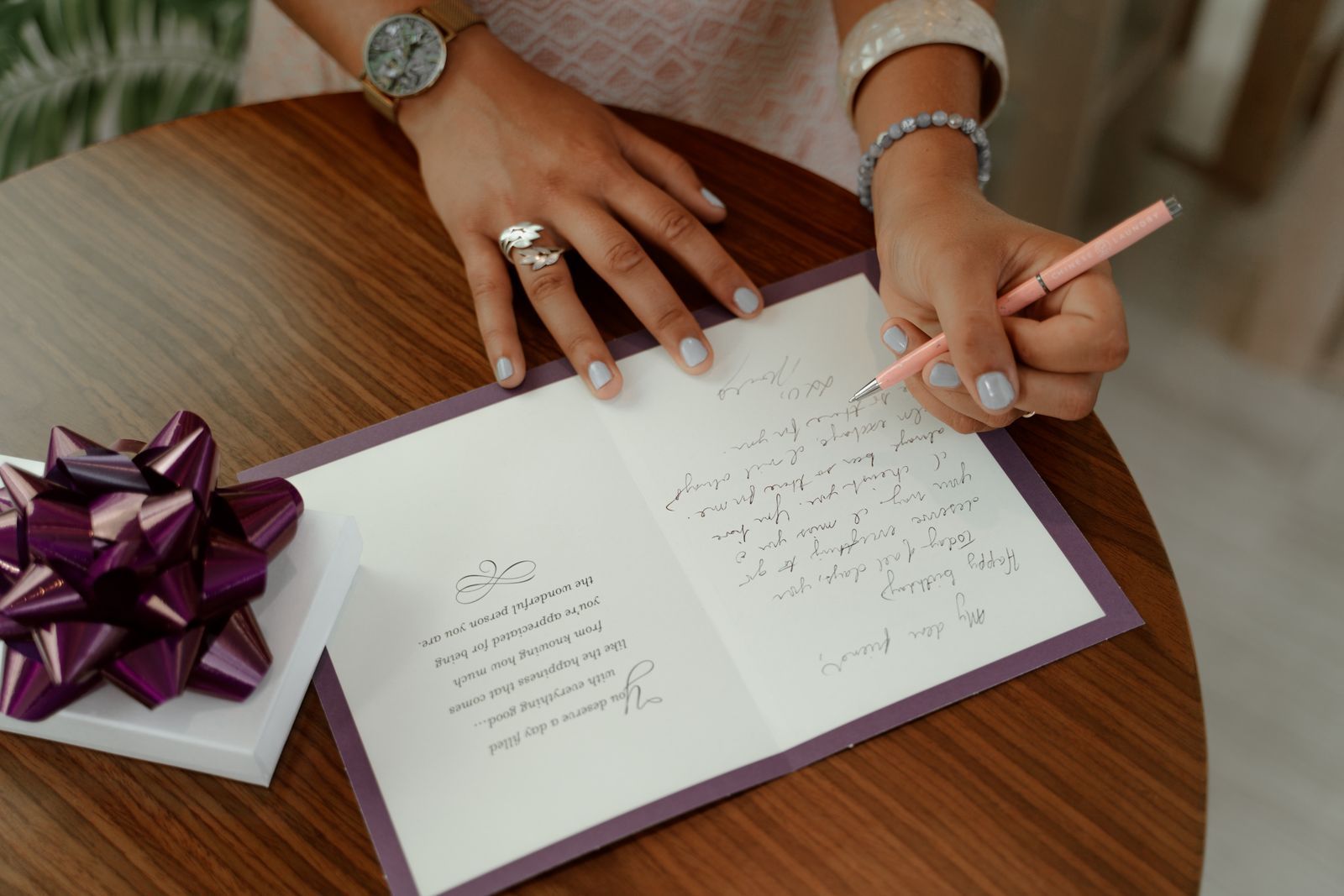
Handwriting is worth the effort when you can hand the letter over. The slope of your letters and the word you crossed out are part of what the reader keeps. Typing is better when the letter has to travel, when your hand is not steady, or when you want it to go out on a set date. Neither is more sincere. If you type it, try the first draft with a pen anyway. A pen slows you down, and slow is good here.
Before it goes, read it to yourself in an empty room. If a sentence could have gone in last year's card, cut it. Any sentence you feel slightly shy saying because it is so plainly true, keep. If you would like your child to hear the letter in your voice as well as read it, how to record your voice for your family shows how to do it simply at home.
Questions to Answer Before You Write
Before you start the letter, answer three or four of these on scrap paper. Each one asks for something no template and no chatbot can know, because only you were there. Three good answers make a better letter than fifteen thin ones.
This year. What you saw, and when.
- The moment this year you were proudest of them, when they did not know you were watching.
- Something they did that surprised you, and why it did.
- A sentence they said this year that you have repeated to someone else.
- Their hardest week, and what they did to get through it.
Who they are. What you have noticed.
- The thing they do that is just like your own mother or father.
- How they treat someone who is having a bad day.
- Something they care about that you never taught them.
- Something they are already better at than you were at their age.
Your side of the story. What they cannot know without you.
- What you were doing, and worried about, when you were their age.
- One thing about the day they were born, or the day they came to you, that nobody else remembers.
- The Christmas you would live again if you could, and what made it.
- Something you got wrong with them, and what you would do now.
Next year. What you plan, and what you hope for.
- One thing you hope they try.
- One thing you are looking forward to doing with them.
- What will still be true about how you feel, whatever next year brings.
A line from a message website or a chatbot can be perfectly kind and still read as generic to your child, because they know how you talk, and nothing in it could only have come from you.
Example: A Letter to a Small Child
A letter to a small child is written to be read aloud to them now and kept for later. This one is from a father to his daughter, who is six.
Dear Mia,
This letter is about you. I am reading it to you on the sofa, and one day you will read it by yourself.
You are six. This year you lost two teeth, and now you push your tongue through the gap to make me laugh. You learned to swim across the small pool at Riverside without the yellow float. You stood at the edge for a long time, and then you went, and when you got to the other side you said, "That was not even scary," and your lips were blue.
On your first morning at big school you showed your teacher the plaster on your knee before you told her your name.
You kept a caterpillar in a jam jar for nine days and called him Professor. You gave him leaves from the hedge and told him about your day every evening. Then you let him go by the back wall, because you said he missed his family.
You care about fair more than anyone I know. When Grandma cut the last piece of chocolate cake, you made her measure the two halves with your ruler, and then you gave Theo the bigger one, because you had the bigger one last time.
This Christmas, I hope you get the purple boots. I hope Grandpa does the trick with the coin again. And I hope we make the lemon biscuits, and you eat the dough, and I pretend not to see.
I love you more than all the stairs up to our flat. That is fifty-three.
Love, Dad
P.S. This last part is for later, when you are grown. You will not remember the caterpillar. I wanted somebody to.
Read it to her on the day, out loud, and let her interrupt. At a slow pace it takes two or three minutes. Then put the page somewhere safe. At six she will enjoy it and move on to the boots. At twenty she may be very glad of it, because it is the only record of the caterpillar and the cake measured with a ruler.
Example: A Letter to a Teenager
A Christmas letter to a teenage son or daughter after a hard year has one job: to be read to the end. This one is from a mother to her fifteen-year-old daughter.
Dear Lena,
I know a letter will make you roll your eyes. Read it anyway, and then you can roll them.
This was not a good year, and we both know it. You changed schools in February. You and Maya stopped being friends, and I still do not know who stepped back first, and I have learned that I am not supposed to ask. Some weeks you came home and went straight upstairs, and the only sound was the bass guitar through the ceiling. I heard the same four notes a great many times this year.
You also got the Saturday job at the bakery on Hill Street by yourself, and told us only when it was yours. You come home smelling of bread, with a bag of whatever did not sell, and you leave it on the kitchen table without a word. In October, when I had the flu, you made rice and eggs and carried them upstairs on the tray with the broken handle. It was too salty. I ate all of it.
In April, when you told me you wanted to stop swimming, I said you were just tired and it would pass. You were not tired. You had stopped loving it a long time before, you tried to tell me, and I did not listen, because I loved watching you race. I am sorry. You were right to stop.
No advice this year. You have had plenty, from every direction. I only want you to know that I see you, even through a closed door, and I like who I see.
Happy Christmas. The tray is fixed now.
Love, Mum
There is no lesson in it anywhere. A teenager after a hard year has been told what to do by every adult within reach, and a letter that adds one more instruction gets read as one. What lands is the admission: the swimming, named, with the month and no excuse. One plain apology does more than a page of praise. The last line closes a small loop from earlier, the tray, so the letter ends lightly.
Example: A Christmas Letter to an Adult Child
Writing to adult children is the hardest to begin, because the old reasons for a letter are long past. The same shape works for a Christmas letter to an adult daughter or an adult son. This one is from a mother in her sixties to her son, who is thirty-four.
Dear Adam,
There are things I will not say at the table. Your father will start talking about the roads, you will make a joke, and the moment will pass, the way it always does. So here they are on paper, where nobody can change the subject.
You are thirty-four and I am sixty-four. I worked out this week that I have now known you for more than half my life, and you are still the person I am most curious about.
People ask me what you do. I tell them, they nod, and we move on. What I would like to tell them is something else. When your father's hearing started to go, you began sitting on his left side at dinner, so he could hear you without asking you to say it again. Nobody asked you to. Nobody else noticed. I noticed. That is the kind of man you are, and I am prouder of it than of any job.
I see it with Leo too. You kneel down to his height and wait for him to finish his sentence, however long it takes, even at the end of a long day. I watch you do it and I could burst.
I still think about the Christmas you were nine. You saved your pocket money for months and bought me a small glass bird from the market on Station Road. Your brother broke its tail before New Year, and you glued it back yourself, very slowly, at the kitchen table. It is on the windowsill above the sink. You can still see the line of glue.
One more thing, and please read it twice. You do not need to ring more often. You do not need to visit more. When you come, it is the best weekend of my month. When you cannot, I am glad your life is full enough to keep you busy. That is what we raised you for.
Give Jess my love, and tell Leo he may hold the glass bird when you come, if he is very careful.
Happy Christmas, my darling boy,
Mum
Three things carry it. She praises who he is, not what he does, with evidence nobody else saw. She gives him back a Christmas he has half forgotten, down to the line of glue. And she removes the guilt in plain words: no calls owed, no visits owed. A grown child may read a letter from a parent waiting for the request at the end. When none comes, they may read it again.
Example: To a Child Who Is Far Away This Year
Some years a son or daughter cannot come home: a job abroad, a course in another country, a flight that costs a month's rent. This one is a Christmas letter to a daughter studying abroad, from her father.
Dear Sara,
This is the first Christmas you will not be at home, so here is the news first.
The cat still sleeps on your bed and looks at me as if I sent you away. I have learned to use the video call properly, so you will no longer have to look at my ear. I check the weather in Toronto every morning before I check our own. Your mother is making the dumpling soup anyway, the full pot, and we will eat your share.
I owe you an apology for the airport. I made a joke about the size of your suitcase because I could not manage anything else, and you went through the gate thinking your father was being funny. I was not being funny. I was trying not to cry in front of a queue of strangers.
So let me say it properly now. I am so proud of you. You found the flat on your own, you sorted out the bank on your own, and you sound, on the phone, like someone who knows where she is going. Every time you ring I tell the whole street.
Do you remember the Christmas Eve you were eight, when we walked to the footbridge over the railway to look at the lights of the town? You tried to count the lit windows in the tall flats by the river, and got a different number every time, with your mittens on the railing and your breath going up in clouds. I think of you there every Christmas Eve.
Wherever you are when you read this, I hope someone is with you, and there is something warm to eat. You are home at Easter. I have marked it on the calendar in red, three times, and your mother says that is too much. It is not enough.
All my love, Dad
If you post a paper letter, post it weeks early, because a letter that arrives after the holiday reads as an afterthought. Aim for the day before, not the day after. A letter read on Christmas Eve in a rented room can be the first thing all week that feels like home.
A Baby's First Christmas Letter, to Open When They Are Grown
This one is not signed from the North Pole. It is a letter from you, in your own name, about the first year, to be opened when your child is grown. It is from a father to his daughter, who is nine months old.
Dear Ella,
You are nine months old and this is your first Christmas, and you slept through most of it.
You have four teeth, all at the bottom. The first food you refused was carrot. You pushed the spoon away, looked at me, and put your hand flat over your mouth. You still do it.
Nobody in this house calls you Ella. Your brother called you Bean before you were born, and it stuck. When you read this, you can decide whether to forgive him.
Today Grandad held you by the window while we cooked. You pulled the paper crown off his head and a spoon off the table and would not let go of either. You fell asleep holding the crown.
Your mother says you have my hands. I think you have her frown, the one she makes when she is reading.
When you read this you will be grown. I wanted you to have this Christmas anyway, the one you were too small to keep, written down by someone who was there.
Love, Dad
Write down the details you are sure you will never forget: the first word, the song that stopped the crying. Those are often the first to go. For a letter opened on a birthday instead, see letters to open at 18. To keep this one in a box with the hospital bracelet and the first shoes, a time capsule letter explains how to make a paper capsule that lasts.
From a Grandparent at Christmas
A Christmas letter to your grandchildren can be shorter and lighter than a parent's. It does not have to carry the whole year, only the part you shared. This one is from a grandmother to her grandson, who is eleven.
Dear Jonah,
Your grandad says a letter is too much fuss for a boy of eleven. I told him eleven is the perfect age for one, and that he could write you his own if he felt so strongly, and he went off to look for his reading glasses, which were on his head.
This year you grew taller than me. You did it in August, while I was not looking, and now you rest your arm on my head as if I am a fence post.
You helped me plant the plum tree in March. You dug the hole too deep, then too shallow, and then, after a cup of tea and two biscuits, just right. (Your grandad will tell you the tree was his idea. It was not.) And you said, "Gran, when it has plums, I get the first one." I agreed. Now it is in writing.
Your mother was eleven once too. She was just as stubborn and just as kind, and she also put her elbows on the table. I never told her it was all right. I am telling you.
Come and stay at New Year. The spare bed is made, and I have bought the orange juice with bits in it that only you drink.
Merry Christmas, my tall boy,
Gran
Telling a grandchild what their mother or father was like at their age is something only a grandparent can do. For that, and everything else a grandparent might want to put on paper, from family history to a grandchild not yet born, see a letter to my grandchildren.
Short Lines for a Christmas Card to Your Children
Some years a card is all there is time for. These twelve short Christmas messages are a start, four each for small children, teenagers and adult children. Use one as a first line, then add one thing only you saw. The square brackets are where yours goes.
For a small child:
- This year you learned to [ ]. I loved watching you do it.
- The funniest thing you said this year was "[ ]". I have told everyone.
- You asked me why [ ], and I still do not know. Ask me again next year.
- Every drawing you gave me is on the fridge. There is no room left, and I am glad.
For a teenager:
- I do not say it enough, so here it is in ink: I like who you are.
- This year was hard, and you kept going. I saw it most on the day you [ ].
- You do not have to have it all worked out. I did not, at your age.
- Whatever next year brings, there is always a seat at the kitchen table.
For an adult son or daughter:
- I still tell people about the time you [ ]. It is still my favourite story.
- This year I finally [ ], the thing you kept telling me to do. You were right.
- The [ ] you gave me is still the one I use. Thank you for knowing me that well.
- When I think of this year, I think of [ ]. Tell me what you think of.
A line is a start. If one of these makes you think of a moment, write the moment underneath it, and you are halfway to a letter, which is the real gift.
How Your Letter Arrives
There are three ways to deliver it, and the plainest is often the best. Hand it over in person, the evening before or on the day, and let them read it alone first if they would rather. Post it, with their name written by hand, if they live away, and post it early. Or schedule it, which suits a child who is far away, a letter for a Christmas years from now, or a letter you want to write tonight while the year is still fresh.
For the third, there is Goodbye App: free, in fifteen languages, on the web and on Android, with letters delivered by email to the people you name. You pick the day and the hour it goes out: this Christmas, or a Christmas up to thirty years from now. If your child lives in another time zone, allow for the difference. Nobody sees it until it is sent. If you switch on the optional inactivity setting (anywhere from 3 to 45 days), your letters can go out earlier if your account goes quiet for that long.
A letter carries your words and one recording of your voice. If you want to send a photo, that goes in a scheduled post, which can be shared only with the people you choose. A small child with no email address yet can have it sent to the other parent, with their name in the first line.
If You Are Writing for Christmases You May Not See
Some parents reading this are thinking less about this Christmas than about the ones after it, because they are seriously ill and may not be there for them. If that is you, here is the most important sentence on this page: you do not have to write one for every year. One letter is enough. A single Christmas letter that says what you see in your child, what you remember, and what you hope for them can be read again and again for the rest of their life.
If you have the energy for more, write them in the order that matters most to you, and stop whenever you need to. Our guide to birthday letters for the years you might miss works through how many to write, and letters after a terminal diagnosis covers what to write first when energy is short. Neither asks you to do it all.
Common Questions
How long should a Christmas letter to my children be? Between 200 and 400 words: a page or two by hand, or two to three minutes read aloud. Shorter for a small child, longer for a grown one.
Should I handwrite it or send it by email? Handwrite it if you can put it in their hands, because the page itself becomes part of the gift. Email it if they are far away or you want it to go out on a set date. Or do both: keep the handwritten page for the next time you see them, and send the same words by email.
What do I write to a grown child I am not close to? Something short that asks for nothing: one true memory, one thing you respect in them now, and a plain line saying the door is open, with no conditions. Leave out the history of who said what. A letter that needs nothing back can be read without fear. If they have asked you not to contact them, respect that: a letter is not a way around it.
One letter for all my children, or one each? One each, even if they are short. Brothers and sisters compare, and a letter with only their name at the top tells each child they were seen on their own. Keep them close in length, so nobody counts the lines.
Is it too late to start a yearly Christmas letter? No. Start this year, at whatever age they are, and say so in the first line: "This is the first of these, and there will be one every Christmas from now on." A tradition begun when your child is forty is still a tradition by the time they are fifty.
Can I schedule a letter for a Christmas years from now? Yes, if it goes by email rather than on paper. Use an address you expect them to keep for years, and do not promise them a particular minute: email takes its own time.
Can I put a photo in the letter? On paper, yes: tuck a print in the envelope. By email, keep the letter to your words and your voice and send the photo separately, as How Your Letter Arrives explains.
Every person has a legacy®
Begin