Somewhere in your family a decision has been made, probably on the phone and probably in a hurry, that one of the grandchildren should say a few words at the funeral, and that grandchild is you. Now you have a eulogy for a grandmother to write. You have loved her all your life, and you will be standing in front of people who loved her for longer, two of whom may have raised you.
Here are five speeches for a grandmother and one for a grandfather, in the voices of grandchildren from a fifteen-year-old to a grandson in his forties. One is written for three cousins to read together. The minutes are printed above each, and after each one is a line or two on why it works or how to deliver it. After the speeches come the parts that belong to grandchildren in particular: speaking in front of her children, and turning one of these into your own.
What a Eulogy for a Grandmother Asks of a Grandchild
You are speaking in front of her children. One of them is your mother or your father, who has just lost a mother. Your aunts and uncles are in the same row. Anything you say about her is also, quietly, a sentence about their childhood, and they will hear it that way. Say it anyway, and make sure nothing in it competes with what they have lost.
You probably knew only her last decades. You met her when she was already a grandmother: slower, softer, with more time and fewer rules than her own children remember. It is easy to feel that this version does not count, or that you have no right to stand up while people who knew her at thirty sit behind you.
There are cousins, and there is one slot. A family with eight or twelve grandchildren rarely gets eight or twelve speeches, and the question of who speaks can turn into a small argument in a week that does not need one.
The obituary and her children will cover the life. You are there for the part of it that happened at her house: the after-school kitchen, the summer visits, the Sunday phone calls, the rules that applied nowhere else. That grandmother was real, and in some ways she was a different person from the mother her children had. Only her grandchildren can describe her, and this time you are the one standing up.
Picking the Speech Closest to Yours
The grandmothers here are invented. Put your own family's name for her where Nan or Granny stands, and her dish where the bread with butter and sugar is. The note after each speech says what makes it work, so you can do the same with your own material.
Start from the speech whose situation is nearest yours, even if nothing else matches, then check the minutes printed above it against the time you have. Run times assume about 130 words a minute, the pace of a speaker reading slowly in a full room, so most of the speeches here take about three and a half minutes, the three-voice one about four, and the teenager's about two.
If you need one- or two-minute versions, our short eulogy examples have them, along with the full answer on length. If you would rather start from a blank page than from a model, the step-by-step method is in our guide to writing a eulogy. And if it is your mother you are writing for, there is a separate page of eulogies for a mother.
From a Granddaughter She Helped Raise
About three and a half minutes aloud. A woman in her thirties whose grandmother did the school runs and the after-school hours while her mother worked.
From the age of five until I was twelve, my grandmother met me at the school gate every day at a quarter past three, and after that I walked to her house on my own. She was always early, always in the same blue coat. By four o'clock, at her kitchen table, two things were waiting: a cup of tea with far too much milk in it, and a slice of bread with butter and sugar.
That was how our family worked. My mother was a nurse, on day shifts at the hospital, and the afternoons belonged to Nan. Every school day until I left school, she sat down opposite me at that table and asked the same question. "Who was kind to you today, Button?" Button was me. Nobody else was allowed to call me that.
Not what did you learn. Not were you good. Who was kind to you.
When I was seven, the answer was usually a girl called Sophie who shared her pencils, and Nan nodded as if this were important news. It was. Some days the answer was nobody. She did not rush to fix that. She poured more tea and said, "Then tomorrow you go first." It took me years to understand that she meant: tomorrow, you be the kind one.
When I was fifteen, I stopped answering. I sat at that table with one earphone in and gave her nothing, for most of a year. She asked anyway, every day. Then one afternoon in November, when school was as bad as it ever got, I took the earphone out and told her all of it. She did not interrupt once. When I had finished she said, "Thank you. Now, who was kind to you today?" I said, "You were." She said, "Well, that's a start," and cut me another slice.
At six every evening my mother came in from the hospital, and before her coat was off, Nan gave her the day: who had been kind, what had gone wrong, what I had eaten. Mum, the afternoons were Nan's and the evenings were yours, and I never once felt a gap between them. You were at work so I could have all of that. You were a team, the two of you, and I was the lucky one in the middle.
On her last good afternoon I sat by her bed at four o'clock and asked her the question. She thought about it properly, the way she always made me think about it. She named two nurses, the man who brings the tea round, and my mother. Then she said, "Now you."
So I have a small thing to ask of you. Ask someone you love who was kind to them today, and then sit still and listen to the whole answer, the way she did.
Why it works: the room hears the same question at seven, at fifteen and at her bedside, and watches a child grow up without being told. Her name for the speaker, said once, shows what only this grandchild had. The paragraph to the mother does the delicate work. It thanks her without measuring her against her own mother, and it gives her a share of those afternoons instead of a place outside them.
From a Grandson Who Lived Far Away
About three and a half minutes aloud. A grandson who grew up in another country, saw his grandmother once a year and spoke only half of her language.
I did not know my grandmother the way most of you did. I grew up a nine-hour flight away, in another language, and I saw her for three weeks every summer. The rest of the year she was a voice on the telephone on Sunday afternoons.
I spoke about half of her language. She spoke almost none of mine. So every Sunday my mother handed me the phone, and my grandmother talked, fast and warm, and I understood perhaps one word in three. After a while I stopped chasing the words and listened to the sound instead. I could tell from her voice whether her knee was bad that week, or whether she was worried about me. I said yes and no and thank you in the wrong places, and she never once corrected me. She just carried on, as if we were having the conversation she wanted.
She learned three words of my language for me. Hello. Eat. Tall. That was all of it, and she used it brilliantly. At the airport every summer she held my face in both hands and said, "Hello. Tall." Then, at her flat, before my bag was even in the bedroom: "Eat." I have had much longer conversations that said a great deal less.
Those summers had a shape. The heat on the stairs up to the fifth floor. The balcony full of herbs in old tins. The soup she made every day of my visit, because when I was seven I said I liked it, and she took that as an instruction for the next twenty years.
For a long time I felt guilty about the distance. That I did not visit more, that I never learned the language properly, that my cousins had her every week and I had her once a year. This week I have decided to put that down. She never treated three weeks as too little. She treated them as three weeks and filled every day, and by the time I left she was already counting toward the next summer. She never held the distance against me. She loved me from there.
Every year at the door of her flat she said the same thing as I left. I am going to say it now, in her language, with the accent she never minded. [Her phrase, written the way it sounds.] It means, more or less: go carefully, and call me when you land.
One more thing, to her and to everyone here who spoke her language with her every day. I am going to learn the rest of it from my mother, a little every week. It is too late to talk to her in it. It is not too late to understand all of you.
[Her phrase], [the name you called her]. I will go carefully.
Why it works: the distance is named in the first breath, and the guilt is put down in the open instead of apologized for. The room already knows how far away he lived. What it wants is what the summers were like. Then one sentence in her language does what a paragraph in his cannot. Rehearse that sentence with someone who speaks it, and write it on your page the way it sounds, so the spelling does not stop you at the lectern.
Dementia: When She Called Me by My Mother's Name
About three and a half minutes aloud. A granddaughter in her thirties, speaking with her mother in the front row.
In her last years my grandmother called me by my mother's name, and I let her.
My mother is Carol. I am Jess. For the first few months, every time Granny called me Carol, I corrected her. "It's me, Granny. It's Jess." And every time, a small worry came into her face, as if she had made a mistake she could not find, and I could not keep doing that to her. So one Sunday I simply answered to Carol. She smiled at me as if I had just come home from school.
When she thought I was Carol, she talked to me the way she must have talked to my mother as a girl. She told me to wear a vest because it was cold out. She asked if I had finished my sewing for school. She asked whether that boy from the bakery was still walking me home, and told me, very seriously, that he had kind eyes but no prospects. That boy, it turns out, is my dad. He is sitting next to my mother. His prospects worked out fine.
She told me I was the fastest swimmer in my year, and that she was sorry she had never once come to watch. She told me she was proud of me for standing up to the headmistress. My mother has since confirmed the headmistress. Nobody had mentioned her to me in thirty-four years.
Week by week, I got to know a girl I had never met. A girl who swam fast and sewed badly, who argued with headmistresses and let a boy from the bakery walk her home. A girl my grandmother loved so much that, forty years later, she was still worried about whether that girl was warm enough.
My mother drove over every morning before work for three years. Some afternoons nothing any of us said reached Granny at all. But on Sundays I sat in my mother's place and heard what my grandmother had been wanting to tell her daughter all along.
This last part is for my mother.
Mum, I was only ever standing in for you. Everything Granny said on those Sundays, she was saying to you. She was sorry she never came to watch you swim. She was proud of you about the headmistress. She thought Dad had kind eyes, whatever she said about his prospects. And she wanted you to wear a vest, because it is cold out. I wrote them all down after every visit, on the backs of the car park tickets from the care home. There are a hundred and forty of them in an envelope in my bag. They are yours.
Thank you, Granny, for letting me meet her. And thank you for calling me by the best name you knew.
Why it works: the hardest fact is in the first line, and the speech never tries to explain the illness; it says what those years were like for the people in them. The confusion becomes family history, and at the end the speech turns to its real audience in the front row and hands the mother what was said to her through someone else. Show this one to your parent before the day. The words were meant for them, so let them decide which are read aloud and which stay in the envelope.
A Short Speech for a Teenage Grandchild
A short eulogy for her gran, about two minutes aloud, from a fifteen-year-old in her own words.
I'm Maya, and I'm the youngest of Gran's grandchildren.
Gran was the only person I know who texted with full stops. Every message. "Hello Maya. It is Gran. Did you win." No question mark. Ever. And she signed every single text "Love, Gran," in case I thought someone else was texting me from her phone.
"Did you win" was about football. She asked every Saturday. She did not understand football at all. She called the goalkeeper "the one who isn't allowed to run about" and felt really sorry for him.
When my exams started last year, she texted me every morning at seven. "Good luck Maya. You are clever. Love, Gran." Every morning for three weeks. I didn't always reply. I wish I'd replied more. But I kept all of them. I've got two hundred and eleven texts from her on my phone, and every one of them ends the same way.
The last time I saw her, she asked me to show her how to send a photo. So I showed her. She took one of me from across the table and sent it to me straight away. The text said, "This is you. Love, Gran."
At her house you were allowed pudding before dinner if it was raining. That was her rule. It rained a lot at Gran's.
I don't really know how to finish this. Gran always said that when you've said what you came to say, you stop. So I'm going to stop the way she did. Love, Maya.
For the adult helping: let a teenager choose whether to speak, and let them change their mind on the day. Keep their own wording, even the parts you would polish, because the full stops are funny only when a fifteen-year-old has noticed them. Print it in large type, and have an adult they trust stand beside them holding a copy. Two minutes is plenty, and less is fine.
When Several Grandchildren Speak Together
Yes, several grandchildren can speak at a funeral, and the simplest shape is one speech written for several voices, not three speeches in a row. Each of you takes a part, nobody repeats a story, and the room meets her once, from three sides. The speech below is for three cousins and runs about four minutes aloud. Each takes one room of her house, and all three say the last line together.
Eldest: There are eleven of us, so we did what Nana would have done. We divided up the house, fairly, which took two days. The other eight are standing behind us, and their names are in the order of service. I am the eldest, and I have the kitchen.
Nana's kitchen was where every one of us learned to be useful. You were not allowed to sit in it with empty hands. The first time you stayed over, at about six years old, she gave you a small knife and a bowl of potatoes and said, "Thin. Potatoes cost money." Every Sunday for thirty years there were between nine and twenty people at her table, and not one of us ever saw her sit down before everyone else had a plate. She could feed all of us from one pot and still send everyone home with a jar of something. I asked her once why she never ate first. She said, "I eat while I cook. Who do you think tastes it?"
Middle: I have the garden. Her garden was mostly washing line. The beans had one corner and the roses had another, but the line was the important part, because the line was where she listened. If something was wrong, you went outside and handed her pegs. She never looked at you while you talked. She looked at the sheet she was hanging, and somehow that made it possible to say things. I told her out there that I had failed my driving test, three times. I told her I was moving to the city. I told her I was getting married before I told my own parents, and she hung up a whole pillowcase before she said, "Good. He folds things properly."
Youngest: I have the front room. The front room was for visitors, and for news. On an ordinary day you were in the kitchen. If something mattered, she took you into the front room and closed the door. Good news and bad news, both. New babies. Exam results. The phone call about Grandad. She sat in the green chair by the window, you sat on the sofa, and she heard the whole thing before she said a word. Then she put the kettle on, and that meant it was going to be all right. I was the last grandchild she took into the front room. It was in the spring. She told me she was not going to get better, and then she asked about my exams, because she said that was the more interesting subject.
Eldest: For as long as any of us can remember, whoever came in through her back door called out the same thing. "Nana?" And from somewhere in the house, she answered. "In here."
Middle: From the kitchen in the morning. From the garden in the afternoon.
Youngest: From the front room in the evening, when it mattered.
Eldest: The house is quiet now, so today we are the ones answering.
All three: In here, Nana. All of us.
This one splits her by place, which works when the cousins all knew her in the same years. If you span decades, split by decade instead, so nobody tells the same story twice. Rehearse the order once, all together and out loud, so nobody misses a cue. Give each speaker their own printed copy with their lines marked, and agree who reads on if one voice goes. If more than three or four of you want a part, or the parish allows only one speaker, let one read while the others stand and are named, and let the rest speak at the meal. If one grandchild must give the eulogy on behalf of all the grandchildren, the eldest or the one closest to her is a natural choice, but the right one is whoever the cousins agree on.
For a Grandfather, From His Grandson
A eulogy for a grandfather from a grandson in his forties, about three and a half minutes aloud, for a man who kept his hard early years to himself. A granddaughter can use it almost unchanged.
My grandfather talked more than anyone I have ever met. He talked to bus drivers, to the man in the newspaper shop, to the television, and to me, about almost everything: football, the price of bread, how to tell when a melon is ripe. Almost everything. The one subject he never talked about was the first twenty-five years of his life. If you asked, he said, "Oh, I worked," and went back to the melon.
On Sunday his younger sister, my great-aunt Elena, called me from the town where they were born. In forty minutes she told me what he had not told me in forty-four years.
He left school at eleven to work at the brickworks with his father. At nineteen he came to this country with an address on a piece of paper and not one word of the language. For four years he shared a room with five other men and worked nights in a laundry, and every month he sent half of what he earned home, so that Elena could stay at school. She said to me on the phone, "Everything I have, I have because he slept in a room with five men."
I did not know any of that. When I put the phone down, I thought about chess.
He taught me chess when I was eight. He took ten minutes over a move, sometimes more, and if I hurried, he put his hand over my piece and said, "Look at the whole board first." I thought that was just how old men played. Now I think it was something he decided. A man whose young years had no time in them, who worked nights and queued for his papers and counted every coin, chose to spend his old age being the most patient person any of us knew.
He never told us how hard it had been, and I used to think that was a pity. That was a decision too. He did not want us to carry it. He wanted us to have the football and the melons and the chess, and a grandfather who argued with the television. He gave us the easy version of himself on purpose, and it took him his whole life to build it.
Elena could not travel today. She asked me to tell you that she was a teacher for forty years because of him. Elena, thank you for telling me. Now I know where the patience came from.
Grandad, I still play, and I am still slow. My son is eight. I have set up the board.
Why it works: the late discovery arrives quickly, as a handful of facts with a named source, and is then turned back on memories the whole room shares, so everyone sees their own afternoons with him again. The speech never blames him for keeping quiet. It reads the silence as a choice made for the grandchildren. If you learned something this week that changes the man you knew, say where you learned it, keep it to three or four facts, and let it explain one thing you already loved. If he is better told through one thing he kept, the object speech in our unconventional eulogy examples is built on a different model.
Speaking in Front of Her Children
Tell your parent, your aunts and your uncles what you plan to say before the day, so nothing lands as a surprise. Ask each of them one question, such as what she was like when they were small. You will get a story you can use, and they will know you are speaking with them, not over them. Do not correct family history in public. If your uncle tells a story wrong, let him. Some memories belong to her children first: the house they grew up in, the hard years they lived through with her. Leave those to them, or ask before you borrow one.
A eulogy for your grandma should say Grandma, and a eulogy for your nan should say Nan. Use the name she answered to at home, whether that was Oma, Abuela or something only your family said. In some languages the word itself tells the room which side of the family she came from, so use the one you used, not the formal one.
Five Questions Only a Grandchild Can Answer
Before you borrow a single line from above, spend twenty minutes with these five questions. They are written for a grandparent's eulogy, and the answers are usually the parts nobody else in the room can tell.
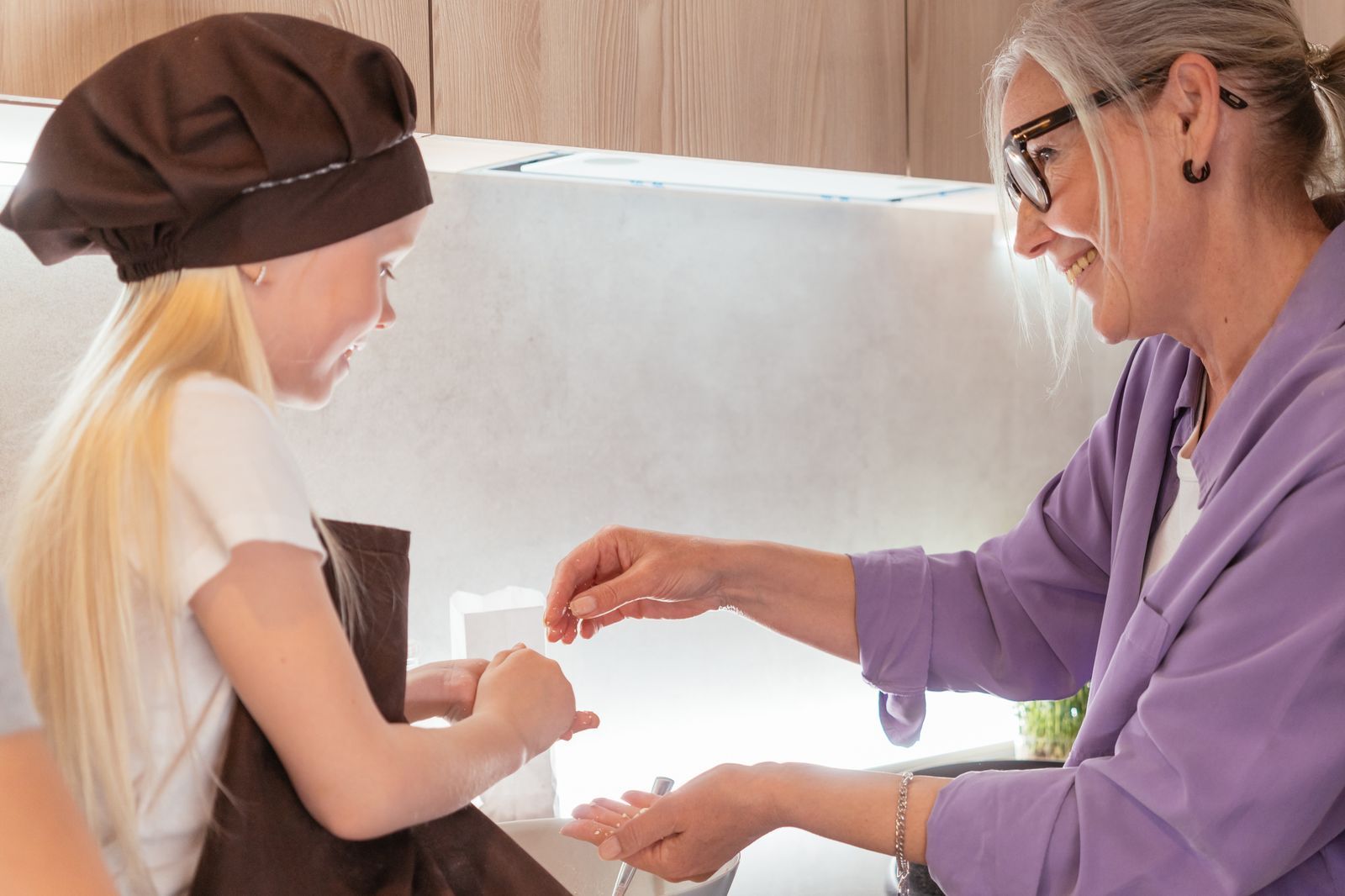
- What was allowed only at her house? Staying up late, pudding before dinner, the good chair, the television during meals. The exceptions she made for you tell the room who she was with you.
- What name did she have for you? Not the one on your birth certificate. If it embarrasses you slightly, it belongs in the speech.
- What did her house sound or smell like at one exact time of day? Seven in the morning, Sunday at noon, the hour before a family meal. Choose the hour first, and the details will come.
- What did she say about your parent as a child? Ask your parent. It gives you a story from before you were born, and it gives your parent a quiet part in your speech.
- What did she keep? The drawer of string, every birthday card you sent, your school photos in order on the landing. What a grandmother keeps tells the room what she was paying attention to.
Pick one answer to build on and use the others as detail. When you have a draft, read it aloud to a cousin. A cousin had the same grandmother from a different angle, and will catch the story that belongs to someone else: the one your aunt is planning to tell, or the one that happened to your brother and not to you. They may also give you back the detail you forgot.
The Questions Still Worth Asking
Writing this, you have probably found the questions you never asked her: why she left the town she was born in, what she was like at twenty, what she meant by the thing she always said. Some of those answers are still in the family, and the people who hold them are near you: her children, and perhaps a grandfather who is still here.
Our questions to ask your parents before they die work just as well for a grandparent, and recording your voice for your family covers how to actually make the recording. Nobody needs to do this in the week of a funeral. The questions are often easier to ask once the house is quiet again, and an afternoon of those answers, in a voice you know, is something the whole family can keep.
On Goodbye App, you can write a letter to the people you name and add a recording of your own voice, and so can a parent or grandparent who is still here. You pick the day and the hour each letter goes out by email, up to thirty years ahead, and it stays private until it is sent. It is free, on the web and Android. If a surviving grandparent wants to write to the grandchildren, our guide to writing a letter to your grandchildren is written for them.
Common Questions
How do I start a eulogy for my grandmother? With who she was to you, in one plain sentence that uses the name you called her: "Nan met me at the school gate every day for seven years." Then go straight into one scene. Thanks and the outline of her life can wait, or be left to the printed program.
How long should a eulogy for a grandmother be? Three to five minutes is usual for one speaker, and two to three each when several people speak. The speeches on this page run from two minutes to about four, and our short eulogy examples page has one- and two-minute versions.
Can several grandchildren give one eulogy together? Yes. Write one speech for several voices, with each of you taking a part, as the three cousins do above. If only one of you can speak, one can read for all while the others stand and are named.
What if I did not know my grandmother very well? Say so in one sentence, near the start, and then speak about the part you did know: the visits, the phone calls, one afternoon. Ask your parent for one story from before you were born, and say whose story it is. An honest small speech is better than a borrowed large one.
Should a child or teenager speak at a grandparent's funeral? Only if they choose to. Give them the choice, let them change their mind on the day, and keep an adult they trust close by. A younger child can take part in the planning instead, by choosing a poem or making a card.
Can a grandchild speak during a church funeral? Often, but ask first. At a Catholic funeral Mass, in many dioceses the words of remembrance need the priest's permission and come after Communion, just before the final commendation. Other churches and faiths have their own customs, so ask whoever leads the service. If there is no room, speak at the vigil if the parish allows it, or at the wake, the graveside or the meal.
What if I cannot get through it? Stop, breathe and look at the page until the line comes back, and give a spare copy to someone near the front who can finish it if it does not. The rest is in our guide to reading a eulogy without crying.
Every person has a legacy®
Begin