
On the eve of his seventy-second birthday, a grandfather in West Long Branch, New Jersey wrote eighteen pieces of advice for his five grandchildren and dated it April 8, 2012. Five months later James Flanagan had a heart attack and died. Nobody, least of all him, had called it a last letter. It was simply a letter to my grandchildren, written by a well man on an ordinary spring day because he had things to say and no reason to wait.
That is the version worth copying. The hard parts are not the feelings. A four-year-old has no email address.
Why Grandparents Write a Letter to Their Grandchildren
A parent writes to a child about the child. You can do what a parent structurally cannot: hand over the generation before the parents. Your grandchild's mother or father is a character in your story, not its author, and you are the only living person who can describe them at nineteen. That is information, not sentiment, and it goes out of print when you do.
If you want the general form, values and a blessing addressed to everyone, that is the legacy letter. If you are the parent rather than the grandparent, the version that goes occasion by occasion covers a child too young to remember you.
Robyn Fivush and Marshall Duke at Emory followed families with children aged ten to twelve for two years, starting just before September 2001. Children whose families discussed hard family events in coherent, emotionally open ways came through better on almost every measure: higher self-esteem, better friendships, less anxiety, fewer behavior problems. A letter is how that talking continues after the talker stops.
What Only You Know
Harvest before you write. Not memories in general: facts that die with you. The test is whether their parent could answer the question; if yes, skip it.
- What their own mother or father was like at twenty-five. Broke, funny, frightened of the sea.
- How the surname is spelled, what it was before, and who changed it.
- The crossing, if there was one. What was in the bag, who stayed on the platform.
- The trade. What your hands knew, who taught you, what you were paid.
- The house that no longer exists. What it smelled like on a Sunday, which stair complained.
- Who was cut off, why, and whether you now think it was right.
- The language nobody speaks any more, and who spoke it last.
List first, letter second. People who stall here are not short of feeling. They are feeling and remembering at once, which is two jobs.
Then open on a fact, not a feeling: a feeling on line one has nothing to lean on. "You were three the day you told me the sea was too loud" gets further than "you have always been so special".
Writing Across a Language Your Grandchild Cannot Read
In 2019, 67.8 million people in the United States, almost one in five, spoke a language other than English at home, up from 23.1 million in 1980, says the Census Bureau. In a family the pattern runs downhill: you speak the language, your children understand it, your grandchildren answer in English.
Which leaves you writing to someone who cannot read you. Three honest ways through, and no fourth.
- Write in your language, with a translation beside it. Ask your own adult child, not software. Your daughter knows the phrase your mother used was a joke about a neighbor, not a proverb.
- Write in their language, badly, on purpose. The errors are the accent on the page, and a grandchild will recognize you in the mistakes.
- Record it in yours, summarize in theirs. They hear you before they understand you, which is the order they knew you in.
The third is worth more than a line, because what a page cannot carry is almost all sound. How the family names are really pronounced, before a registrar flattened them. The village, said the way people there said it.
So record a piece that is only sound. Say each family name slowly, then at speed. Say the place names. Then whatever is spoken rather than written in your family: the prayer, the toast, the counting rhyme, the lullaby nobody printed. It is the pronunciation key to a family, and nobody can rebuild it once you are gone. The technique is in how to record your voice for your family.
Goodbye App runs in fifteen languages, so you can compose in your own; it does not translate the letter.
Family History Written as a Person, Not a Chart
The commonest failure is turning into a genealogist. Dates and places are a database, and databases are online. What only you can write is a person doing something. One story per generation is the spine, and four generations is plenty.
My grandmother Anna could not read. She signed the shop ledger with a cross, then checked every figure in it from memory, and she was never once wrong. When she died we found the ledger, the crosses, and a page at the back where she had been practicing her name.
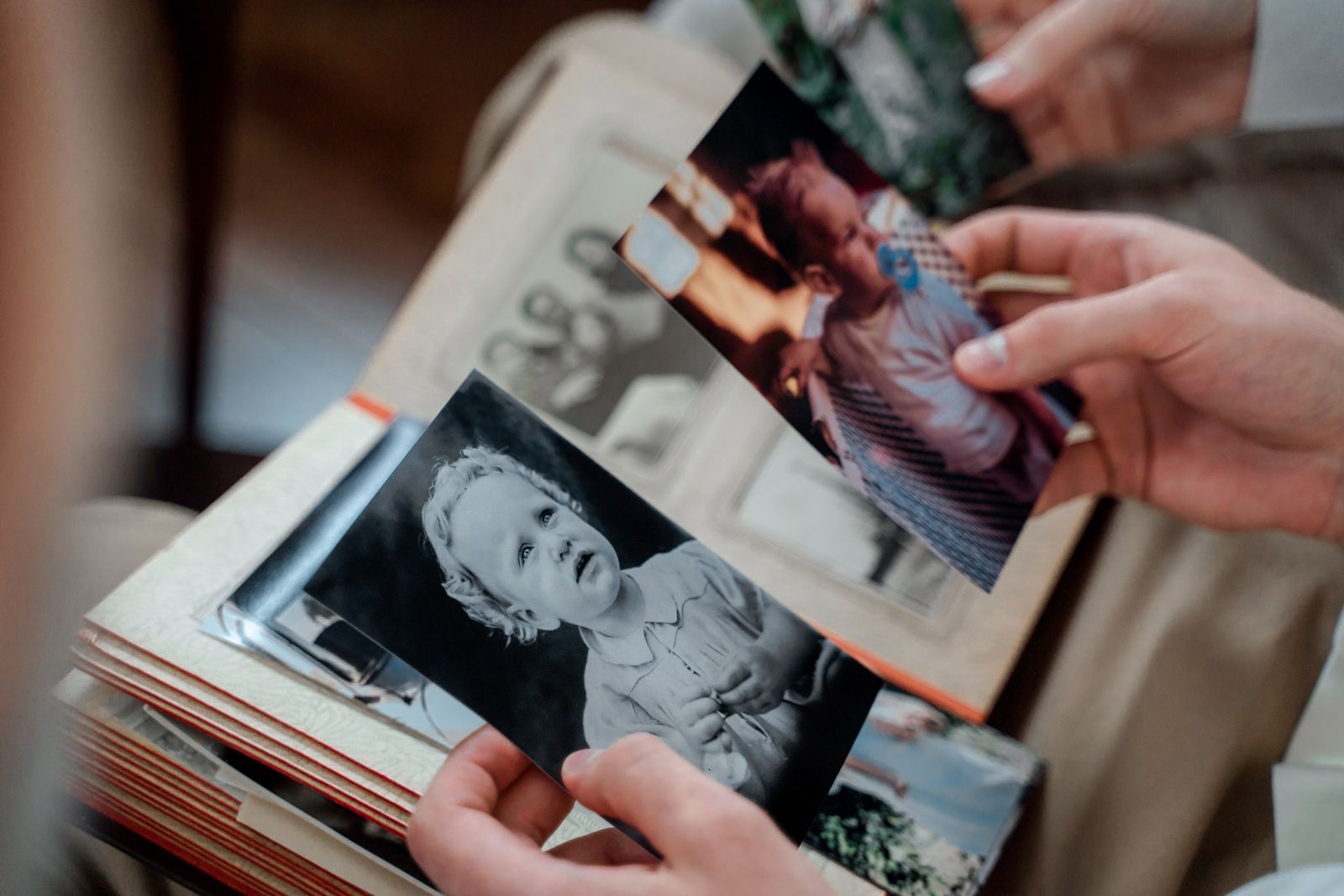
Do the same with photographs, which get separated within a generation from the person who could explain them. Describe two or three inside the letter, where the words cannot come loose.
Your great-grandfather is standing in a doorway in a white shirt, sleeves rolled. He is squinting because it is August and because he hated having his picture taken. The dog is Rex, who was not friendly. The doorway is 14 Mill Street, which is gone now.
A Letter to a Grandchild Not Yet Born
In November 2015 the Wall Street Journal columnist Jason Zweig published a letter to grandchildren at least a decade from being born, built around his mother leaving the family house after fifty years, to tell them things it had taken him decades to understand. Being further along than they are is the only qualification this letter needs.
You cannot describe them, so describe yourself completely instead. Your full name and what you were called. Where and when you were born. Your parents' full names, including your mother's before she married. What you did for a living and whether you liked it. One thing you changed your mind about.
Do not presume them. No "you probably have your mother's laugh". Leave the name blank until you meet them.
I do not know your name, or whether you exist yet. I am writing anyway, because everything I want to tell you is true either way, and because I would rather be early than absent.
Doing the Arithmetic on Your Own Window
Ten minutes with a calculator changes what you write. In 2024, an American who reached 65 could expect on average 19.7 more years, 20.8 for women and 18.4 for men, says the National Center for Health Statistics. An average, not a verdict. Each cell below is your age at that grandchild's eighteenth birthday, then at their thirtieth.
| Your age now | Grandchild aged 0 | Grandchild aged 5 | Grandchild aged 10 |
|---|---|---|---|
| 60 | 78, then 90 | 73, then 85 | 68, then 80 |
| 65 | 83, then 95 | 78, then 90 | 73, then 85 |
| 70 | 88, then 100 | 83, then 95 | 78, then 90 |
| 75 | 93, then 105 | 88, then 100 | 83, then 95 |
This is a measuring stick, not a list of occasions. At 70 with a two-year-old granddaughter you would be 86 at her eighteenth and 98 at her thirtieth: a coin toss, then a letter. It sets your tone too. If you will plainly be there for the eighteenth, spend the writing on the thirtieth. Write to the adult.
One Letter to My Grandchildren, or One Each?
Both, in a fixed proportion. Write the family history once, addressed to all of them; repeating it four times will exhaust you. Then give each grandchild a short personal note: what you noticed about them, what you think they are good at, one thing that happened between just the two of you.
Land them on the same date. Children compare mail for the rest of their lives, and a letter that arrives for one cousin and not another becomes a fact about the family. Different lengths are survivable. A missing letter is not. Step-grandchildren get one, and not a shorter one: the test is not blood, it is whether they have called you a grandparent name. Christmas or New Year makes an easy shared date, and our page on writing to them at Christmas includes a letter from a grandmother.
The Grandchild You Do Not See
In a 2025 YouGov survey of 4,395 American adults, 38 percent said they were currently estranged from a relative, 9 percent from a grandparent and 6 percent from a grandchild. Among grandparents estranged from a grandchild, 35 percent said someone else was responsible for the break: it is often not between the two of you. Write anyway, and leave the case out: no defense of your conduct, no argument about their parent. A letter that arrives with terms is a summons.
I am not going to argue my side. You are entitled to yours. What I can give you is the one thing nobody else can: the part of your family that happened before you, told straight. If you ever want the rest, I am not hard to find.
What to Leave Out
Six things belong somewhere else.
- Money, and who gets what. Who inherits the ring belongs in a will, made the way the law where you live requires; a wish in a letter can leave your family arguing over what you meant.
- Grievances against their parents. You would be asking a child to hold something against the person raising them, with no right of reply.
- Other people's private facts. Your daughter's diagnosis is hers to tell.
- This year's politics. Whatever is furious now reads like a fossil in 2050. Write the principle, not the headline.
- Instructions about grief. How often to visit a grave, how sad to be. It does not buy what it hopes to buy.
- Passwords, typed out. If your letter touches the codes for a phone or an account, write where your password logbook is kept and who else knows. Same for documents: record where they live.
Great-Grandchildren and What Survives Fifty Years
In 2020 a man in Rio Linda, California found a journal on the seat of a truck set for the auction block where he worked. It held letters from a 91-year-old woman named Lola Maxine to her granddaughter Arabella Raine, the most recent dated 2013. He rang the two numbers written inside. The Los Angeles one never answered; the South Carolina one had never heard of either name.
Set that beside Taylor Giany, who found a note from her grandfather tucked behind a photograph in a family album. He hid it there and died in 2003; she found it more than two decades later, by accident. It began "How's grandpa's sweet girl, I sure do miss you".
Neither letter failed because of the paper. Paper lasts. What neither writer controlled was whether it reached a named person on a day they chose.
A great-grandchild is that problem in its pure form. You will almost certainly never meet them, so you cannot use a name or even be sure of the relation: whoever opens this may be a great-grandchild, a great-niece, or somebody clearing a house. Write to the person holding it, identify yourself the way a document does, and name the town. A letter signed only "Grandma" cannot be reunited with anybody. If you want it opened on a fixed date rather than found by luck, a letter sealed for a date decades away has its own rules.
Getting the Letter to a Child With No Inbox
Two answers work. Send it to the parent with the instruction on the outside: this is for your daughter, please give it to her when she can read it herself. Or set the date far enough out that she has an inbox of her own, which suits anything you would rather a parent did not read first. You still have to name a recipient the day you write, so use an address that works now and swap it for hers later; letters stay editable and reschedulable right up until they go.
This is what Goodbye App is for. It is free, on the web and on Android. You write the letter, or record it in your own voice, name who receives it, and choose when: an exact date up to thirty years out, or after you are gone, which you set by picking an inactivity threshold and letting it run. Until then nobody sees it, and you can edit, reschedule or delete it whenever you like. Every other route is compared in how to send a message after you die. A letter is only a letter until it arrives.
Common Questions
What do you write in a letter to your grandchild? What only you can supply: their parent as a young person, the house that is gone, the trade, the crossing, the name that got changed. One story per generation rather than a list of dates, then a short passage about the child. The facts are what disappear.
How do you start a letter to your grandchild? With a fact rather than a feeling, because a feeling on line one has nothing to lean on. To a grandchild not yet born, say you do not know their name and are writing anyway.
Should I write one letter for all my grandchildren or one each? Both. The family history once, a short personal note to each, sent on the same date and step-grandchildren included: a letter that arrives for one cousin and not another is remembered as a verdict.
What if my grandchild does not read my language? Have your own adult child translate it beside your original: a person catches the family jokes software smooths away. Or write in their language badly on purpose. Or record it in yours with a short summary in theirs.
How do I make sure it actually reaches them? Assume the envelope in a drawer will not be found by the right person at the right time. Tell one living person it exists and where, and put your full name and the date on it. If the reader is small today, address it to a parent with instructions, or schedule it years ahead to an address that works now and swap in theirs later.
Every person has a legacy®
Begin


