
One of the biggest open when letters pages on the internet lists 280 ideas, and others list well over a hundred. Between them that is hundreds of prompts for envelopes labelled Open When You Miss Me, Open When You Cannot Sleep, Open When You Got The Job. Not one of them is for the day you die.
So if you have searched for open when I die letters, you already know the shelf is empty. The format came from long distance couples and deployments, where the writer comes home. Take the writer away and the order, the pacing, the custody and the contents all change.
What an Open When I Die Letter Actually Is
The mechanic is old and simple. You write several letters, seal each one, and write the moment it is for on the outside. Open When The House Is Too Quiet. Open When You Get The Keys. While you are alive you hold the set together: you can be asked, you can add one, you can say not that one yet. Once you have died, the envelopes do the holding themselves.
That is what separates a set from a single sealed letter left in case something happens, which is one letter, one moment, one delivery. A set is not a goodbye. It is a filing system for your own absence, and that needs an order, a custodian, a stop rule, and a way of arriving.
Why People Write a Set Instead of One Letter
First, a correction. The most shared example of this format is fiction. When I'm Gone, about a father who dies at 27 and leaves his son envelopes labelled with the occasion, is a short story by Rafael Zoehler. It is still circulated as a true account.
The real sets look different. Jacqueline Zinn died of brain cancer in 2013 at 56, leaving four children. She wrote more than a dozen letters, each for a specific milestone, while paralysed on one side. Her son Jerry opened the first after her death and the second when he graduated from UNC Chapel Hill in 2016.
Heather McManamy of McFarland, Wisconsin was diagnosed with stage 2 breast cancer in April 2013 and told it was terminal in August 2014. She wrote more than 40 cards for her daughter Brianna, then four, for random encouragement, bad day, wedding, driver license, even first breakup. Not a life summary. A list of moments she would miss.
There is a reason the shape works. Since Dennis Klass, Phyllis Silverman and Steven Nickman published Continuing Bonds in 1996, grief research has largely treated a lasting connection with the dead as normal rather than a failure to move on, and a set gives it a calendar.
How Many Open When Letters Should You Write?
Zinn wrote more than a dozen. McManamy wrote more than 40. Kris Saim wrote 74. None of those is your answer: all three knew roughly how long they had.
For most people the honest range is five to ten envelopes in total, across everyone. The first six are the ones only you can write, because they attach to people and things you actually know. By envelope thirty you are writing to a stranger in a situation you invented, and it shows. An unfinished forty is worse than a finished six: whoever gets it will notice there is one for their sister and none for them.
How many birthday letters to write, and for which years is a separate decision with its own arithmetic.
Choosing the Occasions Across a Whole Set
Most people choose occasions one at a time and end up with five letters saying the same thing in five costumes. The skill is not picking good moments. It is getting a spread.
Check the list against three axes. Soon and late: one arriving in the first year, one in the fifteenth. Hard days and good days: a set of triumphs is no use on a Tuesday in February. One person and everyone: at least one envelope for the household.
Then group by recipient rather than by occasion. Sort the piles by name and the gaps appear: four for one child, none for the other, three for your partner that all say sorry. A husband or wife works better as one full letter than a series.
The standard milestones already have their own guides: birthdays across the years you might miss, the eighteenth and the year by year tradition, weddings and graduations. What no list gives you is the unglamorous half: the first bad day, the week they clear your house, the first time they need advice you gave for free.
What Goes Inside One Envelope
One envelope, one moment, one voice. The common mistake is treating each letter as a small autobiography, so every one of them opens with a summary of your life and the reader learns nothing after the second.
Name the moment in the first line, so they know you pictured them there. Tell one story properly instead of four in outline. Stay sensory: the sound of the car, the brand of biscuit, the thing they said at eleven. A page is achievable nine times over. Four pages is not.
It is your first day at the job you were nervous about. I am writing this on a Wednesday in March, years before it, with the dog asleep on my feet, and I already know how you will have done your hair.
Date every letter and sign it. In a set the dates say which version of you is speaking.
The Open First Letter, Which Runs the Whole Set
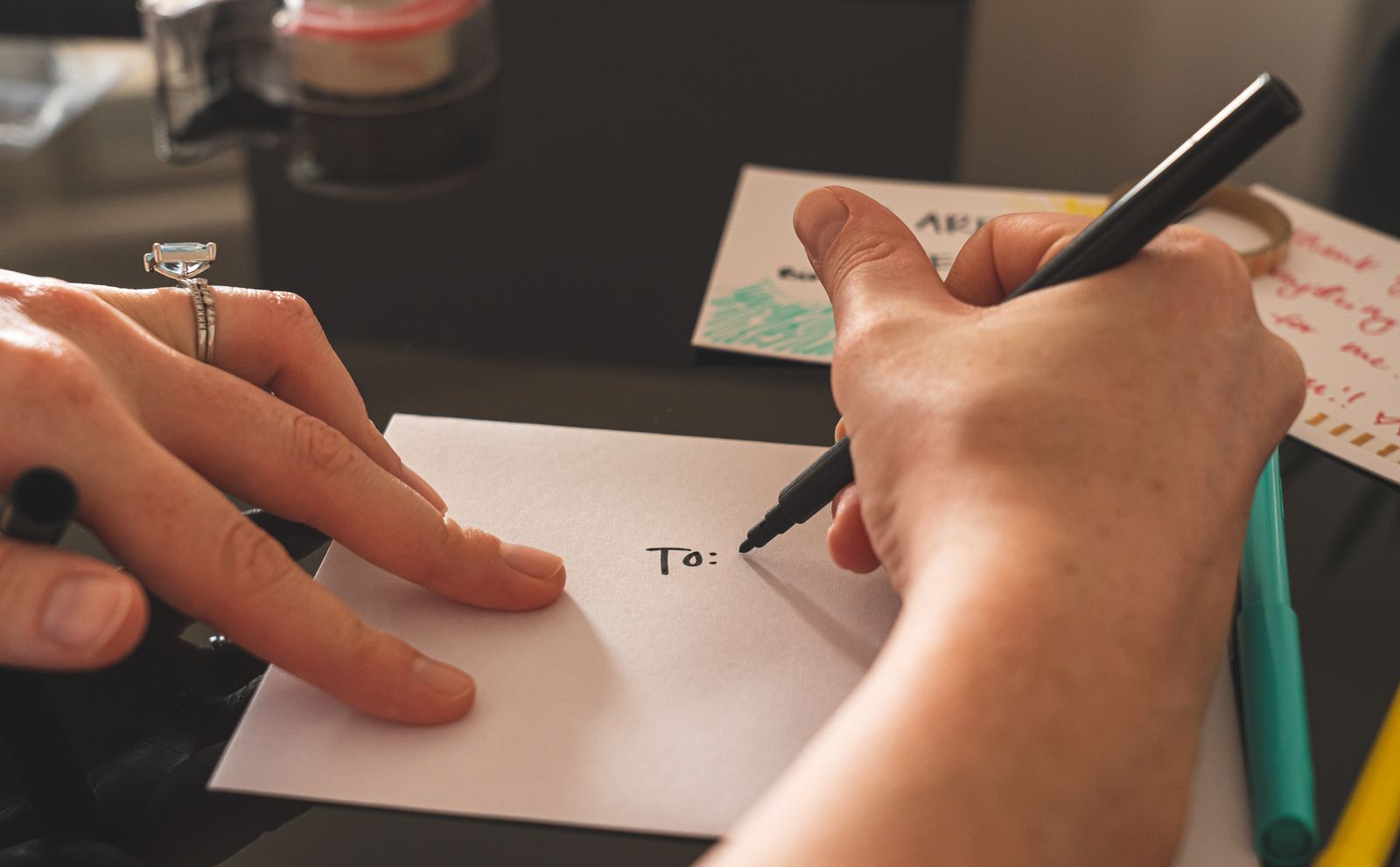
The craft version of this format has an Open First letter, and every guide tells you to write one. What none of them writes is the version for a set with no living writer behind it, and that is the envelope that decides whether the rest work. It is not a letter about you. It is the instruction sheet for whoever is holding a bundle of sealed paper in the worst week of their life. Five things belong in it.
- An inventory. How many there are, and who each is for.
- The order, and where there is none. Which are tied to a moment and which are not.
- Permission not to read them. Some people cannot for two years, and should not feel they failed you.
- Permission to stop. If one lands badly, they put it down for good.
- What happens to the unopened ones, if a moment never comes.
There are nine of these. Six are for you, two are for your brother, one is for whoever ends up looking after the house. You do not have to read them. Not now, not ever, not in the order I put them in. If one lands wrong, put it down and do not pick it up again. Nothing here is a test and none of it expires.
The Envelopes to Skip
Every other page lists occasions to include. Here is the list nobody writes.
The letter that becomes a condition. One of Jerry Zinn's envelopes was reserved for his college graduation, and a letter that only arrives if you graduate is also a reason to graduate. It is told as heartwarming, and it is. It is also leverage over a living person's choices, years after the writer could revise it. Zinn did a loving thing under impossible pressure; the lesson is about design. An envelope that has to be earned becomes a debt, so attach letters to moments that happen to people, not to achievements.
The letter that grades a life you did not see. Anything beginning I hope you finally, or by now you will have, is a report card written before the term. Write pride in the past tense.
The letter to a person who may not exist. Open When You Get Married is addressed to a spouse the recipient may never have, or may already have left. Label by feeling instead: Open When You Love Someone Enough To Be Frightened.
The logistics envelope. Nobody can grieve and administer at the same time, so keep the contacts, the pets, the funeral wishes and the location of your documents on their own page. One rule for that page: do not type live passwords into it. Write down where the logbook lives instead.
The envelope that gives something away. A line like and I want Sarah to have the ring, sealed inside a letter, has either done nothing or started an argument. Letters are not wills. Keep bequests in the will and ask a lawyer.
The Delivery Problem a Set Creates
A single letter has one job: reach one person, once. A set has a job that runs for a decade, and three failure modes of its own.
One custodian, many envelopes, many years. Handing a friend one letter is a favour. Handing them nine, for four people, across fifteen years, is an unpaid administrative post. They have to remember, still have the box after two house moves, and not die first themselves.
Nobody left to ration them. Whatever pacing you wrote into the open first letter, no living person holds the line. The realistic outcome is the whole set opened in one afternoon, in the wrong order, by someone who could not stop.
The careful filing is the failure. Sealed inside a home safe is usually the worst version, because the combination lived in the head of the person who died. The better a set is protected, the longer it takes to arrive.
Choose the delivery before the ninth envelope, not after. Every way a set can actually be delivered is compared there.
One Way to Hold a Whole Set
Those three problems are one problem: a set needs something that remembers dates and recipients for years without a person having to. That is the job Goodbye App does. Each letter carries its own recipients and its own date, up to thirty years ahead, so the set arrives spread out instead of in one afternoon, and each stays private until it is sent.
A set stays editable: any letter can be rewritten, rescheduled or deleted before delivery, which makes it safe to write the twelve year envelope now. Separately, you can turn on an inactivity safeguard and choose a threshold between three and forty five days. If it fires, every unreleased letter goes then, whatever date you had put on it, so it is a release switch rather than a schedule.
The logistics get their own home, out of the love letters: guided sections for contacts, funeral arrangements, device and website access codes, and where your important documents are kept. That last one is a note of where the papers live, not a vault holding them. It is free, and not a will.
Adding Your Own Voice
A recorded envelope carries what paper cannot: the laugh in the middle of the sentence, the pause before the hard part, the way you say their name. For a set, the sensible pattern is a written letter for every envelope and a recording for the two or three carrying the most weight. Your own voice, recorded by you, not a replica assembled afterwards. How to record each envelope covers the technique.
Which Open When Letters to Hand Over While You Are Alive
Kris Saim was 52, with stage IV colon cancer. He wrote 74 letters by hand during chemotherapy infusions, to colleagues, friends, people he had wronged, and earlier versions of himself. Then he did the opposite of sealing them. He reads each one aloud to its recipient over video and lets them answer, which became a podcast called Dying Out Loud. His line: "The conversation you're postponing is costing you more than you know." Heather McManamy, counting the cards she managed to hand over herself, put it this way: "Every one of these that I get to hand out in person will be an accomplishment."
So test every envelope before you seal it. Is it sealed because the moment has not happened yet, or because you have not said the thing yet? The first kind is what open when I die letters are for. The second kind is a conversation wearing an envelope, and it belongs on a Sunday, in person, while you can watch them read it.
A good set ends up smaller than you imagined and better than you feared. Six or eight real envelopes, an open first letter that gives permission rather than orders, a delivery route that does not lean on anyone's memory.
Common Questions
What is an open when letter? A sealed letter labelled with the moment it is meant for, so the recipient opens it when that moment arrives. The format comes from long distance relationships and deployments. Open when I die letters use the same mechanic after the writer has died.
How many open when letters should I write? Five to ten in total, across all your recipients, is where most people can finish and the writing stays strong. The documented sets run larger, but were written by people with a diagnosis and a deadline. A completed six beats an abandoned forty.
What do you write in a letter to be opened after your death? One moment, told in specifics. Name the occasion in the first line, tell one story properly rather than summarising your life, and keep it to a page. Date it and sign it. Leave out practical instructions and anything you are giving away.
Where should I keep letters to be opened after I die? Anywhere except a container only you can open. A home safe whose combination lived only in the head of the person who died is the classic failure, and the best protected sets are the slowest to arrive. The answer is one automatic route plus one human being who knows the other exists, set out in the comparison of delivery methods.
Is a letter left after death legally binding? Generally no. These letters express wishes, not instructions, and do not replace a will. In some places a court can treat an informal document as testamentary if it reads as fixed intent, which is why an offhand line about who gets the ring is a hazard. Ask a lawyer.
Every person has a legacy®
Begin


