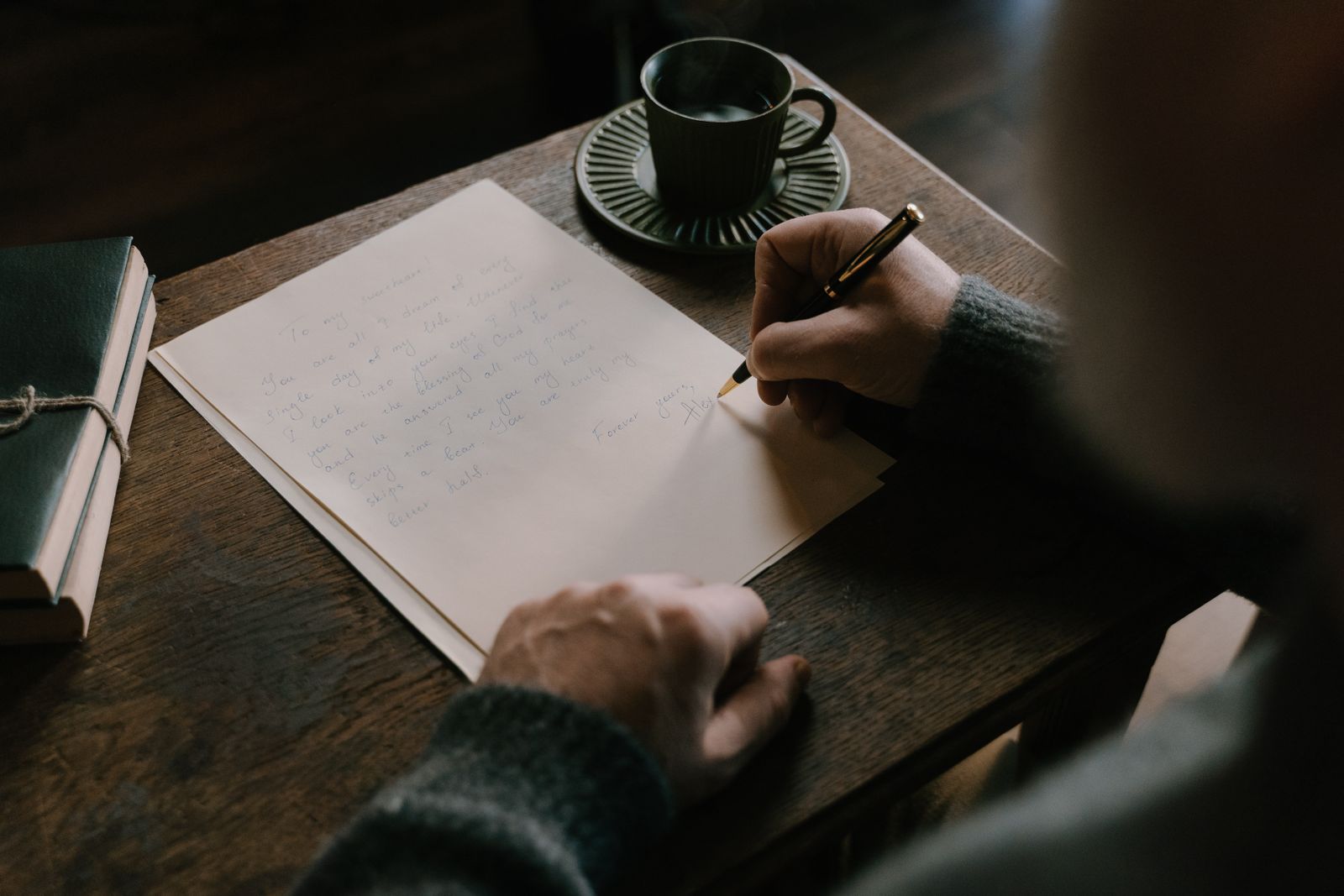
You have been given a few minutes to say what your mother was, and the last few nights have probably gone the same way: you sit down, you write three sentences, and every one of them sounds like a greetings card. That is not a failure of love or of writing. It is what happens when someone has been in every room of your life since before you can remember.
Below are six complete eulogies for a mother, not fifteen openings and a list of adjectives. Three are written from a daughter, three from a son, and each one is a whole speech you could stand up and read tonight. They cover six different circumstances: a long illness, a son who has never been any good with words, a death with no warning at all, dementia, a relationship that was never simple, and one person speaking for a whole family. Each has its run time at the top, so you can pick one that fits the service you have been given.
Why This One Is the Hardest
Mothers are hard to eulogize for a reason nobody warns you about: most of what she did does not survive as a story. It survives as a fact about you. The lunches, the waiting in cars, the fevers she sat through, the forms she filled in, the arguments she absorbed so you would not have to have them with the world. None of that has a shape you can tell in ninety seconds. You reach for anecdotes and find infrastructure.
There is a second weight. The room in front of you is full of people who knew her as somebody else: Gran, Auntie, the woman two doors down, a name on a rota at church. You are the only person there who knew her as a mother, and you are also, on that particular morning, the person everyone is quietly watching to see how you are holding up. Speaker and chief mourner at once is a genuinely difficult job, and it is worth saying out loud that you are not imagining the difficulty.
So here is the relief. You are not required to summarize her. You are required to bring one small piece of her into the room so vividly that everybody recognizes her in it. One hour. One habit. One small thing she did the same way every time. Do that and the speech is done. Everything you leave out is still true, and the room knows it.
How to Use These Six
There is no Ruth, no Bernadette, no broken fridge and no garden centre. The six speakers are composites, assembled out of the way people actually sound at a lectern, and every proper noun in them is a hole with a temporary word sitting in it. So read them the way a builder looks at a house he did not build: for where the weight is going. Lift a paragraph whole and you will hear the join the first time you say it out loud, and so will your aunt in the second row.
Find the one nearest your circumstances and use it as a scaffold. If the illness one is close but your mother never once complained about anything, keep the frame and change the evidence. If you want the whole method from a blank page rather than a model to work from, our guide to writing a eulogy step by step walks the full road, and this page is the worked examples that sit underneath it.
From a Daughter, After a Long Illness
About three minutes aloud, read at a pace that lets you breathe.
My mother ran our entire family on the backs of envelopes. Shopping, birthdays, who owed what to whom, what the doctor had actually said as opposed to what we thought we heard. If you came into her kitchen with a problem, you left with a list, and the list was always shorter than the problem had felt, which I now understand was the whole trick.
I found one from 1998 in a library book last month. It says: passports, Emma's inhaler, ring the bank about Dad, something for Mrs Doyle's boy. One of the four was for somebody else's child. That was her ratio for fifty years.
She was ill for two years and four months. I am going to say that plainly, because she would have. She did not want it called a battle and she did not want to be called brave. She said once, in a waiting room, that brave was for people who had a choice, and that she just had appointments.
What she did in those two years was keep making the lists. From the chair, then from the bed. My brother's car insurance was on one of them. My daughter's school shoes were on one of them. In August she wrote out, in her terrible handwriting, which cousin was not to be seated near which other cousin at a wedding that was still nine months away. She was dying and she was doing the seating plan. We laughed about it at the time. I have thought about it every day since.
Because that is what she was. Not a woman who loved her family in the abstract, a woman who handled things on their behalf so that their days would be smaller and easier. Love in our house was never a speech. It was somebody quietly removing an obstacle before you got to it.
The last list is on her bedside table and I have not moved it. It has four things on it. Three are about us. One says "ring Marjorie back," and I want Marjorie to know that she was thinking about you on Tuesday.
I cannot do what she did. I am not organized and never will be. But I have started writing things down, and started ringing people back, and if every one of us in this room takes one item off somebody's shoulders this week without being asked, she will be running this family for another fifty years. Thank you, Mum. The list is in good hands.
Notice what is missing: not one word of the vocabulary other people put around a long illness. By letting the mother refuse the word brave in her own voice, the speech earns the right to be unsentimental everywhere else, and the seating plan lands as character rather than pathos. A concrete object left untouched, the last list, gives the ending somewhere to stand.
From a Son Who Was Never Any Good With Words
About three minutes aloud.
I want to start by admitting something that every person here already knows. I am not a talker. I have not been a talker since I was eleven. My mother was, and it worked out very well for both of us, because she talked enough for the two of us and she never once made me feel like I owed her sentences.
She would ring me on a Thursday and speak for twenty-five minutes. My total contribution would be "mm," "right," and "is he really." Then she would say, "Lovely to catch up with you, love," and mean it, completely, and hang up. She counted that as a conversation. I have since learned that she would then ring my sister and tell her how I was getting on, having somehow extracted an entire report from forty seconds of grunting.
One Thursday in March she mentioned, somewhere in the middle of everything else, that she had been kept in overnight at the hospital. I said, "Right." She said, "It was nothing, love, they wanted me on a drip." I said, "Mm." Then she went back to the people next door. When she rang off I sat in the van for ten minutes and did not start it. She knew exactly what my "mm" was carrying, every single time, and she never asked me to unpack it.
When I was nineteen I told her I was leaving the course she had been so proud of me getting onto. I had rehearsed it for a week. I got about four words out. She said, "Right. What are we doing instead, then." We. Not you. And then she talked, for about an hour, and by the end of it there was a plan, and I had said almost nothing, and I had never felt more listened to in my life.
That is the thing about her that I want people to understand. She was not filling silence because she was afraid of it. She was filling it so that the quiet ones in her house would have somewhere to stand.
I know she would want me to say something here about how much she loved everybody, and she did, enormously, and she would be doing it far better than this. So I am going to do the only thing I am actually qualified to do, which is keep it short and mean every word.
Mum. Thank you for talking. Thank you for the Thursdays. Lovely to catch up with you, love.
A man who cannot talk is the perfect person to eulogize a woman who could, and this speech knows it. He never apologizes for the shortness, he uses it, and the last line hands her own signature phrase back to her, so the speech ends in her voice and not his. If you are dreading this because you are not a words person, say that in the first sentence and the room will be on your side for the rest of it.
From a Daughter, After a Sudden Death
About three minutes aloud.
Ten days ago my mother and I had a conversation about a fridge. Hers had started making a noise, and she wanted to know whether she should get a man out or just live with it. We talked about it for eleven minutes. That was the last proper conversation I will ever have with my mother, and for days I could not forgive it for being so small.
I have changed my mind about that, and it is the only useful thing I have for you this morning. There was nothing left unsaid between us. There was nothing to say. We had spent forty-one years saying it in eleven minute instalments about fridges and buses and whether I looked tired. If we had known, we would have said something enormous and we would both have been embarrassed. What we had instead was the ordinary daily proof, and the proof was complete.
She was a practical woman who was secretly a romantic. She would drive four hours for a funeral and complain about the traffic the entire way there and the entire way back, and be the last person in the room at the end, doing the washing up. She was the emergency contact on more forms than I can count, and not all of them were ours. When somebody in her road had a bad year, a casserole appeared. She never once described this as kindness. She described it as "well, somebody has to."
There are bulbs in the shed. She bought them three weeks ago and she had marked the bag, because of course she had, with where each one was to go. It is in biro, sloping downhill the way her writing always did after the third line, and it says FRONT, under the window, not the shady bit. I am not a gardener. I am going to plant them anyway, badly, in the wrong places, and in the spring there will be a slightly chaotic version of what she intended, which is a fair description of what she left behind in all of us.
If you are sitting here worrying about your own last conversation with her, because I know several of you are: stop. She did not measure us on the last one. She measured us on all of them, and all of them were good. Talk to your people about fridges. That is what the love is made of. Goodbye, Mum. Somebody has to say it, so it may as well be me.
Half the room is privately carrying the same fear, that the last thing they ever said to her was about nothing. This speech names that in its second sentence and then takes it apart, which does more work in a sudden death than any tribute could. Note also that the unfinished task, the bulbs, is left deliberately imperfect instead of promised perfectly, which keeps the ending honest.
From a Son, After Dementia
About three and a half minutes aloud, the longest of the six.
My mother had dementia for the last six years of her life, and I have noticed that when people found that out, their faces did a particular thing. So I want to get the six years out of the way at the start, and then I want to spend the rest of my time on the seventy-nine.
The six years were hard. They were hard for her, which is the part we are least able to know, and they were hard for my sister, who did most of it. There were also good days in them, and afternoons that were genuinely funny, and I am not going to pretend those six years were nothing but loss. But it was six years. It does not get to be the headline of a life that ran to eighty-five.
So. Before all that. My mother was the fastest reader I have ever met. She did the crossword in ink. She could tell you the plot of any book in the house and where she had been sitting when she read it. She taught in the same school for thirty-one years and if you have ever been served in a shop by someone who suddenly says "you will not remember me, but," that is what the rest of our childhood sounded like, everywhere we went.
She had opinions, all of them load-bearing. She thought rudeness to waiters told you everything. She thought people who said they were too busy to read were saying something else. She was wrong about at least two major things and she never once conceded either of them, and I am not going to name them now that she cannot answer back.
Near the end, she did not know my name. She knew that I was somebody who was allowed. And there was a song, a completely ridiculous song from about 1961 that she used to sing while she cooked, and which I would have told you I had no memory of whatsoever. One afternoon in March I sang four words of it without really thinking, and she picked up the fifth. Every time, after that. Every single time.
I have been told that this is common, that music sits somewhere the illness reaches last. I do not care about the mechanism. What I know is that there was something in there that was hers, and it was still hers, and it was singing.
If you came to see her in those years, thank you. If you did not, because you could not bear it, she would have understood that better than you think, and I do not want anyone leaving here carrying that. Remember her in ink. In the shop, being recognized. Wrong about two things, at the top of her voice. That is who is being buried today.
Dementia eulogies fail in one of two directions. They pretend the decline did not happen, or they let it swallow the portrait whole, and the thing that prevents both here is a ratio said out loud: six years named honestly, then seventy-nine reclaimed. Forgiving the people who stayed away is a small, unusual act of grace that many families need permission for.
From a Daughter, When It Was Complicated
About three and a half minutes aloud.
My mother and I did not have an easy time of it. A number of you know that, and the ones who do not can probably feel it in the room, so I am not going to stand here and read out a woman neither of us would recognize.
Here is what is true. She was difficult to please and I spent a long time trying. There were years when we spoke twice, at Christmas and on her birthday, and both calls were short. I have spent a good deal of my adult life in therapy about it, and I am not embarrassed to say so here.
And here is also what is true. She was seventeen when she had my brother and she had nothing, and I mean nothing, and nobody helped her. Whatever she failed to give me, she gave me a great deal more than she was given, and she did it from further back than I have ever had to start from. It took me until my forties to be able to hold those two sentences at the same time, and I can hold them now.
She was funny. Genuinely, sharply funny, and if she liked you, which was not guaranteed, she was the best company in any room. She once told a consultant, to his face, that he had the bedside manner of a parking meter, and my son has never let anybody forget it.
She could not say sorry and she could not say I love you. But she could drive through the night when that same son was in hospital, and be sitting in the corridor at four in the morning with a bag of terrible coffee and not one single word about it. That was the apology. It was never going to arrive in any other form, and I spent a long time refusing to accept it in that one.
Three years ago she said something to me on a bench outside a garden centre. It was about eight words long and I am not going to repeat it here because it is mine. It was not an apology and it was not quite an explanation. It was as close as she could get, and I have decided that as close as she could get is a real thing, and that it counts.
So I am not going to tell you she was a wonderful mother. I am going to tell you she was my mother, that she did better than she was done by, that I am here, that I am standing up, and that I have forgiven her. Thank you for the eight words, Mum.
Say the hard thing in your first ten seconds, then never return to it as grievance. Everything after that is evidence, context, and a single act of generosity toward the woman being buried. Withholding the eight words on the bench is the second move worth borrowing, because refusing to share something is the strongest possible proof that it was real. If your relationship was hard, this shape lets you be truthful without turning a funeral into a hearing.
From a Son, Speaking for the Whole Family
About three and a half minutes aloud.
I have the job today because I am the eldest, not because I am the best at it, and the first thing I did was cheat. I asked everybody for one sentence. This is not my eulogy. This is the family's, and I am only holding the paper.
My sister Ruth says: she never made you feel like a guest in her house, even the first time.
My brother Danny says: she was the only person who was pleased, with no conditions attached, every single time the phone rang and it was you.
Her sister Bernadette says: she was the one who could make our mother laugh, and there were not many.
Her friend Anne, who she met at the swimming baths in 1974 and saw every week for fifty years, says: we never once ran out of things to say. Anne, I checked that twice, because I did not believe it either.
Mr Achebe from number nine says: in twenty-two years she never knocked without something in her hands, and she never stayed long enough to be a nuisance. I had to read that one twice as well, because it is the most accurate sentence anybody sent me.
My wife Cliona says: she was the first person in this family who talked to me about anything other than this family.
My son Tom, who is fifteen and did not want to be asked, says: she never once told me I had grown.
My daughter Niamh, who is nine, says: Nana always answered the actual question. Nine years old, and she has put her finger on something the rest of us took decades to notice. She did answer the actual question. She was not a woman who handled you.
My own sentence took me the longest, because I kept trying to write something worthy of her and everything I wrote was too big. So here it is, small. She was the person I reported to. Forty-eight years of exam results and job offers and one divorce, all of it filed with her, and now there is nobody to tell. I had a piece of good news on the second morning after she died and I had the phone in my hand before I remembered.
That is what we lose when we lose a mother. Not only the person, the audience. So the last thing I will say on behalf of all of us is this: report to each other. Ring Bernadette. Ring Anne. Knock on number nine. Tell somebody the small thing that happened on Tuesday, because she would have wanted to know, and because somebody in this room still does. Thank you, Mum, from every one of us.
The gathered sentences are doing all the work here, and every one of them was collected before a word of the speech was written, which turns a representative eulogy from a summary into a chorus. The child's line is placed where it is on purpose: put the most disarming contribution near the end, just before you take your own turn. If you have been asked to speak for a family, the phone calls that build this are worth more to your relatives than the speech is.
What All Six Have in Common

Take the names out and the same five things are doing all the work, every time.
None of them tries to summarize a life. Each one picks a narrow piece and goes deep: envelopes, Thursdays, a fridge, a song, a bench, one sentence each. Breadth is what makes a eulogy sound like an obituary read aloud.
Every one quotes her. Six words in her own phrasing will put your mother in the room faster than six sentences about her character. Get the wording exactly right, including the bits that are wrong. Families remember cadence, not sentiment.
Every one admits something. An illness that was hard, a son who cannot talk, six years nobody wants to discuss, a relationship that hurt. A speech that admits nothing is not believed, and a speech that is not believed cannot comfort anyone.
The speaker stays the right size. A son, a daughter. Not a biographer, not a judge, not the family spokesman on the meaning of her existence. Smaller is more moving.
Each ending hands the room a job. Take something off somebody's shoulders. Talk about fridges. Ring Bernadette. People come out of a funeral needing something to do with their hands, and the last line of a eulogy is the only place anybody is going to tell them what.
Making One of Them Yours
Do not start at the top of the page. Start by answering three questions on paper, badly, with nobody watching.
What did her hands do? Not what she was like: what she physically did, over and over, in a way you could describe to a stranger. Wiping, writing, driving, sorting, planting, holding the phone in the crook of her neck. Write that down before anything else. A room that has been given a pair of hands to watch in the first ten seconds will follow you anywhere after that, and you can tell the rest in whatever order you like.
What did she say so often you stopped hearing it? Every family has three or four of these. One of them is your last line. You will know which as soon as you write them down.
What did she give you that she was never given? This is the question that unlocks the complicated ones, and it is also the one that turns a pleasant tribute into something people remember, because it puts her in her own history instead of only in yours.
Then ask one person who knew her before you existed. Her oldest friend, her sister, the woman she trained with. Do not ask what she was like, ask what she was like before she had children: what she was saving for, what she was rude about, what she had been planning to do instead. Hardly anybody thinks to ask this, and it is the question a mother eulogy needs and the others do not, because a child's evidence only ever starts halfway through the life. You will be told about a stranger, and she will be unmistakably your mother. And read the draft out loud once, to one person, before the day. On the page you cannot hear the sentence that is thirty words too long.
If You Cannot Get Through It
Almost nobody stands up to do this without being afraid they will not finish. The one arrangement worth making beforehand is a named person in the front row holding a copy, because a speech that cannot fail is much easier to deliver yourself. Everything else about nerves, pauses and the lines that catch your throat is in our guide to reading a eulogy without crying.
The Speech She Would Have Given
You have just watched six people rebuild a woman out of envelopes, Thursdays and half-remembered songs. Every one of them is guessing at something, generously and lovingly, and the only person who could have filled the gaps is the one being spoken about. Your mother knew why she bought those bulbs. She knew what the eight words on the bench meant. Nobody thought to ask her, because nobody ever does, until the week they are writing about her.
You can spare your own family that guesswork, and it takes less time than writing this eulogy has. On Goodbye App you can record a few minutes in your own voice and write letters to the people you name, then schedule them to be delivered by email at a time you choose, from today to thirty years out. Everything stays private until it is sent. It is free, on the web and on Android. Most people record three or four minutes and never do it again, and three or four minutes is enough.
If you would like help with what to put in it, our guide to writing your own eulogy in advance covers the writing, and recording a message for your funeral covers what families actually do with one. Nobody will have to work out why you bought the bulbs, or decide among themselves what your eight words meant. You can simply tell them.
Common Questions
Which of the six should I pick? If what you really want to know is how long a eulogy should be, that is answered properly in our short eulogy examples, along with the pacing and the strict-slot version. Otherwise choose by circumstance rather than by taste: whichever of the six is nearest to your situation has already done the hardest sentence for you. If you have been given a fixed slot, choose by the clock instead, using the run time printed above each speech, and then change the evidence.
Two of us want to speak. How do we split it? Split by time, not by theme, or you will both tell the same three stories. The division that works is one of you taking the years before the illness or before she moved, and the other taking the last two, so the room gets a whole life in order rather than two overlapping summaries. Agree in advance who says the last line, and let the other one stop a beat early.
Is it all right to say she was difficult? Yes, in one honest paragraph, held with love, the way the fifth speech does it. What does not belong at a funeral is a full accounting. The test is simple: say it if it makes her more real, not if it makes you more right.
What about a eulogy for a mother in law? Different relationship, different speech. Lean on the day she made you feel like family rather than on childhood you did not share, keep it shorter than her own children's tributes, and make sure at least one line is addressed to your partner rather than to the room.
I had two mothers. Whose do I write? Whoever you are burying, and say the word you actually used for her out loud, whether that is Mum, her first name, or something only your family understands. A stepmother or an adoptive mother is eulogized exactly like any other mother: one image, a few true hours, and something she said.
Should I write it or speak from notes? Write it in full, then read it. Improvising is a wonderful plan until the moment you look up and see the coffin, and the printed pages are what your hands will be grateful for.
Every person has a legacy®
Begin