
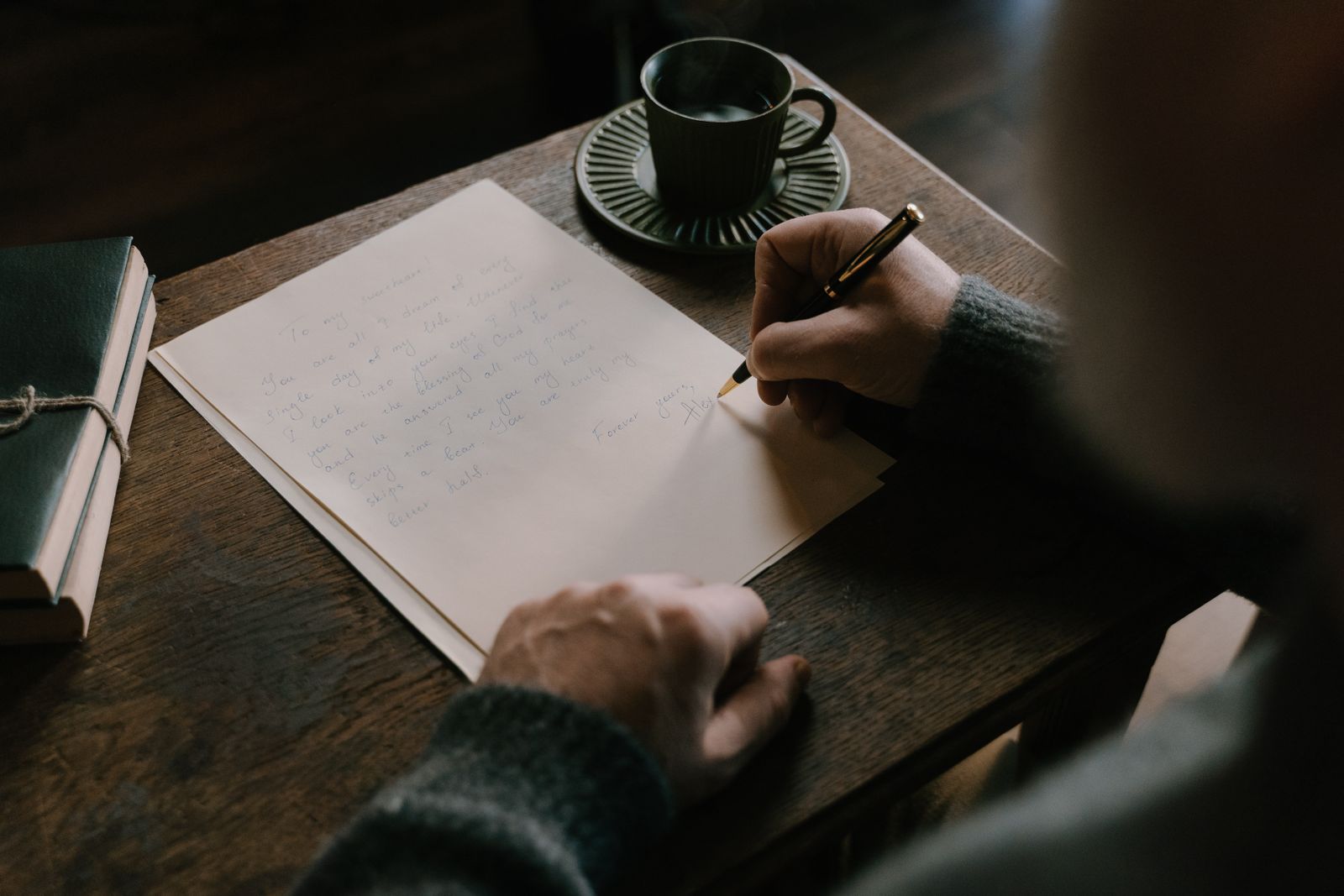
A man sits at his kitchen table with a legal pad, a pen, and the radio off. His wife thinks he is doing the bills. He is writing his own eulogy. Nothing is wrong with him. He sat through his brother's service and heard a minister who had met him once say "he loved his family and his garden." Nobody in that room could have said what needed saying. So he is saying it himself, while he still has the pen. There are two very different reasons to write your own eulogy, and this post is for the second one.
Two Reasons People Write Their Own Eulogy
The larger group wants a reflection exercise: picture your funeral, write what you hope people will say, and let the gap between that and your calendar change a few habits. The smaller group means it literally: a funeral speech for themselves, ready for someone to stand up and read.
This post is for the second group. It covers the decision, the voice, a structure that works in someone else's mouth, and three complete examples. It also covers the part most guides skip: the pages must reach a reader.
Write Your Own Eulogy as an Exercise, or as a Speech
Stephen Covey's second habit in The 7 Habits of Highly Effective People, "begin with the end in mind," asks you to picture your own funeral and answer one question: how do you want to be remembered? Ness Labs offers a prompt in the same spirit. The Art of Manliness version, day 21 of a thirty-day series, has you imagine you lived to ninety.
None of that is wasted if you came here for the literal version. The exercise draft is a first draft of the real thing: cross out the lines that are hope rather than record, keep the ones already true, and you have your opening page.
People Who Actually Did It
Writing your own has a name: the self-eulogy, words written before death for a friend or relative to read aloud. Lou Richards, the Australian rules footballer, left a funny one that a friend read at his service. A famous footballer, and underneath it a plain decision: write it while you can still check it.
Paid services exist too: one UK company charges £195 to hold up to eight minutes of recorded eulogy and pass it to whoever conducts the funeral after death. Most people who do this have no Wikipedia entry and no invoice, just pages in a folder and one person who knows.
Write Your Own Eulogy in First Person or Third Person?
The first decision is grammatical. In first person, your reader stands up and says your words as you: "I was a terrible dancer and I never once let that stop me." In third person, you hand them a script: "He was a terrible dancer, and he never once let that stop him."
Both work. First person is stranger and more powerful: the room hears you, and the reader becomes a messenger rather than a mourner, easier on a shaky voice. Third person is easier to read and easier to revise. A useful middle path is a third-person body with one first-person paragraph at the end: "And now a few lines in my own words."
A Structure That Reads Well in Someone Else's Mouth
Your reader will be doing this on the hardest day of their year, in front of people, possibly through tears. Write for that reader, not for the page. Short sentences. One idea per line. Nothing that needs a breath in the middle:
- One line to arrive. Tell the room what this is: "Before anyone asks, yes, she wrote this herself, and yes, she checked the spelling."
- One story. Not your life story. One incident that was exactly you: the camping trip, the petition about the bins.
- One thank you. Named people, named things.
- One instruction. Something they can do this year: plant the tree, keep the Sunday lunch going.
- One joke. At your own expense, never at theirs.
- One ending. Short, and facing them rather than you.
Three Self-Written Eulogy Examples: Plain, Funny, and One for a Child to Read
All three are invented composites rather than real people, and all are complete.
Short and plain, in first person. Written by a retired second-grade teacher of thirty-one years.
These are my own words, so you can stop wondering who wrote them. I taught seven-year-olds for thirty-one years in a classroom with a radiator that never worked, and I would do every year of it again, including the one with the hamster. I was not a great cook, I was a very good listener, and I could tell which of your children would be trouble by October. I was usually right. Thank you, Graham, for forty-four years of coffee brought upstairs before I asked for it. Thank you, Ellie and Tom, for turning out kinder than I had any right to expect, and for the grandchildren, who are the best thing I ever had a hand in without doing any of the work. I have one request. Read to a child this week. Any child, any book, badly if you have to. It is the whole job, and it takes ten minutes. I know some of you are wondering about the good china. It goes to whoever actually uses it, which rules out most of you. Now go and eat something. The sandwiches are already curling. I loved you all, mostly in the right order. That is everything. Off you go.
Funny, in third person, with the reader written in. A man who ran a hardware store wrote every word of this, including his friend's opening lines.
My friend wrote this himself and made me promise to read it exactly as written, including this sentence. He said if I improved it he would haunt me, and he was a man who kept his promises. He ran the hardware store on the corner for thirty-eight years, and in all that time he never once sold anyone the wrong screw, though he sold a great many people the right screw and then talked to them about it for forty minutes. He would like to thank Pauline, who married him despite the puns, stayed despite the puns, and is, he suspects, a little relieved about the puns. He would like to thank his customers, his bowling league, and his dog, Bolt, who he hopes is under a table somewhere with a sausage roll. He has one instruction. Fix the thing. The tap, the gate, the shelf you have been meaning to get to. Fix it this weekend and think of him while you swear at it. And he asked me to end on the one he was proudest of. After thirty-eight years of selling fixtures and fittings, he has finally become one. He knew you would groan. He was counting on it.
Written for a child to read. A grandmother who kept an allotment wrote this for her nine-year-old granddaughter, with a grown-up beside her.
My grandma wrote this and asked me to read it. These are her words. Hello, everybody. If Maisie is reading this, she is being very brave, and you should all clap for her at the end, even in a church. I was a grandma, a nurse, and the person on Plot 14 who grew the rhubarb nobody could kill. Thank you to my daughter, Claire, who was patient with me even when I was wrong. Thank you to Maisie for every Saturday at the allotment, for the worms you named, and for being the only person who ever really listened to the bit about the compost. I have a job for all of you. Grow one thing this year. A sunflower, a bean in a jam jar on the windowsill, a pot of mint that will take over everything. When it comes up, think of me. Maisie, you get the big trowel now. It is yours. I took it off Plot 12 in 1998 and I have never once felt bad about that. That is all I wanted to say. I had a lovely time, and I am glad you were in it. Now somebody please make sure the little ones get cake first.
What to Leave Out
The temptation, when you have the last word, is to use it. Resist. Four things do not belong.
- Grievances. The sibling who never visited, the colleague who took the credit. A eulogy with a barb is remembered for the barb.
- The will. Who gets the house is a matter for the will, not a speech. A joke about the china is fine; a list of bequests is not.
- Apologies that belong in person. Wrong room, wrong day. Say it now, face to face, or in a private letter.
- Anything you would not want to be your final word on someone. Read every line that names a person and ask whether it is kind.
How Long Should It Be When Someone Else Reads It?
Shorter than you think. A eulogy read by someone else tends to run slower than one the author delivers: the reader is pausing, steadying, sometimes stopping. Most people read aloud at 120 to 140 words a minute, and a shaky reader is slower still, so aim for 500 to 700 words: four to six minutes on the day. Lean low if your reader is family, not a celebrant. For the arithmetic and some very short models, our guide to short eulogy examples has the table.
Who Reads It, and the Backup Reader
A eulogy you wrote yourself needs a reader, and the reader needs to know before the day. Name one person who is steady, who will be there, and who can read aloud while upset. Then name a second, because the first may be the one hit hardest, or ill, or away. That is why understudies learn the lines.
Ask them. Do not leave the pages and hope. One conversation ("I have written something for my funeral, would you read it?") is awkward for one cup of tea, and then both of you sleep better. Put the readers' names with your other wishes, so whoever organizes the day sees them beside the music; our funeral wishes template is the place for it. If you would rather hear it read than miss it, a living funeral is a real option.
The man at the kitchen table told his wife in the end, and the pages got better afterwards, because he had stopped writing them in secret and started writing them for somebody.
Recording It in Your Own Voice
You can also record it. A eulogy in your own voice brings the room your timing, the way you land the joke, the pause before the important bit. Your named reader becomes the person who presses play. Give them the audio file itself, not a link, and ask them to pass it to whoever runs the sound a day early, so it can be tested through the room's speakers. A phone held up to a microphone sounds like a phone held up to a microphone. Some find that easier than reading aloud, some harder. Ask them which.
A recording is only useful if a specific person has it and has agreed to play it when the family chooses. That chain, and an Irish veteran whose recorded joke at his own burial went around the world, are in our guide to recording a message for your funeral. The tips for the recording itself are in our guide to how to write and record a eulogy.
Telling One Person It Exists, and Making Sure It Arrives
Self-written eulogies go wrong for reasons unrelated to the writing. The pages go into a drawer, or a folder on a laptop nobody can unlock, and the reader was never told. A letter to be read at your funeral is only a letter until somebody is holding it. Left where you left it, it is paper in a house about to be emptied by people who do not know to look.
Telling one person solves half of that. The other half is making sure it arrives: to the person you named, on the day it is needed, not one morning sooner. That is the gap Goodbye App was built to close. You write your eulogy as a letter, or record it against the guided prompt: what would you say at your own funeral? You name your reader as the recipient and your backup as a second, and it stays private until it is delivered by email, on a date you choose or after you are gone. That last option runs on an inactivity safeguard you switch on: if you stop signing in for a threshold you choose, between 3 and 45 days, your unreleased letters go to their recipients. Until then you can edit, reschedule, or delete it. It costs nothing.
Revising It Every Five Years
The eulogy you write at forty-five will be wrong by fifty, and that is good news: it means life kept happening. Put a date at the top of the page, a reminder in your calendar five years out, and reread it after a birth, a move, or a loss. The shape will not change. Only the names do.
Common Questions About Writing Your Own Eulogy
Is it weird to write your own eulogy? No. It is a practice with a name, the self-eulogy, done by a famous footballer and plenty of people with no Wikipedia entry. What feels strange is the first ten minutes, and then it feels like ordinary care.
Who reads a eulogy you wrote yourself? A person you choose in advance and ask directly: a close friend, an adult child, a sibling, sometimes the celebrant. Name a backup, and make sure both know how the pages reach them.
Should it be in first person or third person? Either, and the choice is really about your reader. First person puts your words in the room and turns the reader into a messenger, which is easier on a shaky voice. Third person is simpler to read and simpler to set beside tributes of their own. A useful compromise is a third-person body with one first-person paragraph at the end.
Can you record your own eulogy? Yes, and people do. Give the file to a named person who has agreed to play it, and let the family choose the moment. A recording that exists only on your own phone is not a plan.
How do I write down what I want said at my funeral? Use the six moves above, keep it under 700 words, and name a reader and a backup. A letter to be read at your funeral needs a route to the right person.
If you are reading this because you are thinking about ending your life, please talk to someone today. findahelpline.com lists free, confidential helplines in your country, and there is more on our suicide and self-harm page.
Every person has a legacy®
Begin


