
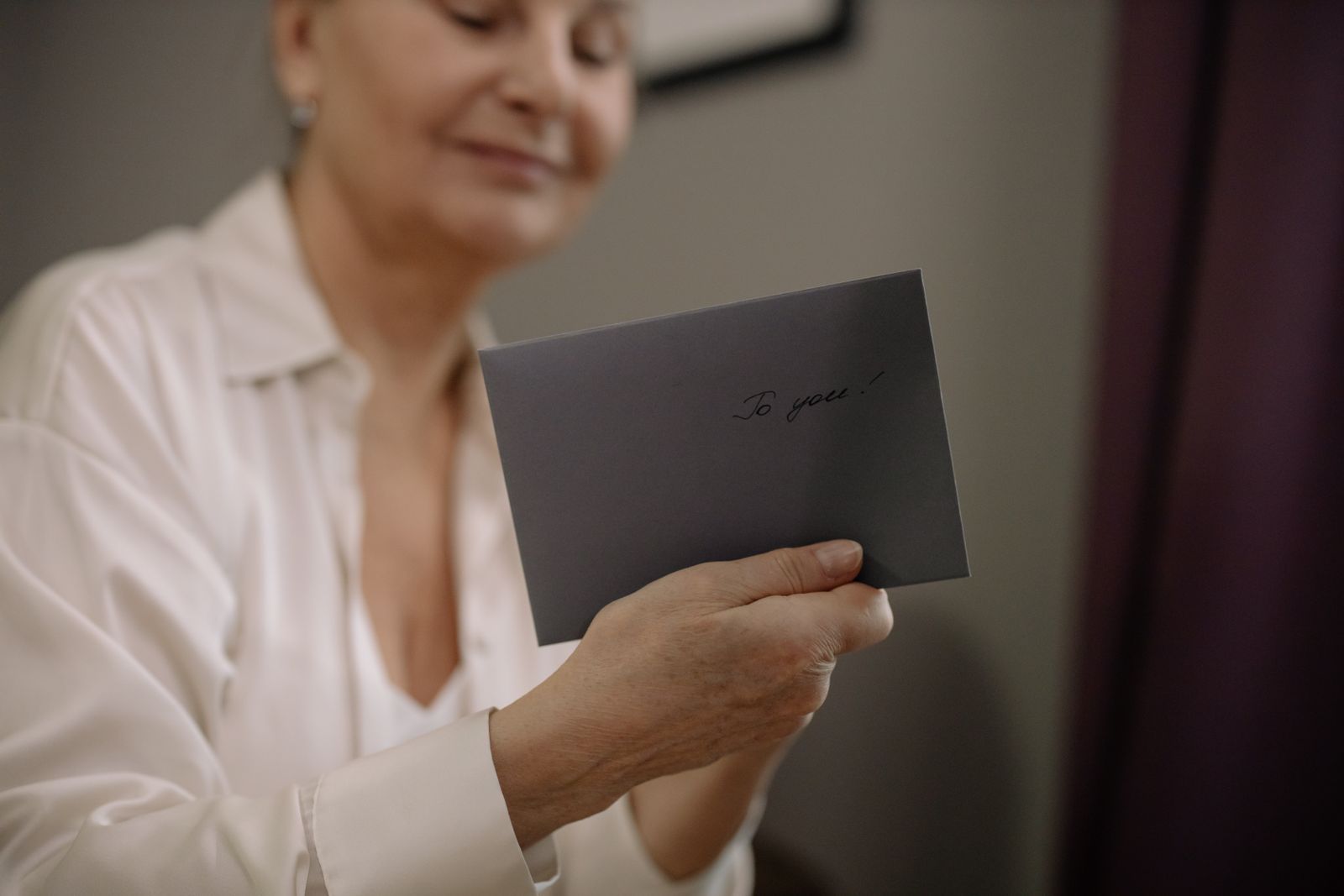
Picture a hospice nurse, an illustration rather than a real case, who keeps plain envelopes in her cardigan pocket. When a patient says they do not know where to start, she puts one on the tray table and asks a single question. If you could write one line to one person, who would it be, and what is the line? It is a question people can answer on a bad day, and what comes back is usually a name and a short line.
After a terminal diagnosis, what to write to your children before you die arrives with a hundred other questions and a fraction of last year's energy. You do not need a project. You need a first envelope, a first person, and twenty minutes. The rest is optional, and written for you, not for the people who visit you.
Start With the Smallest Thing: One Letter, One Person, Twenty Minutes
Pick the person whose face came to mind at the nurse's question. Not the whole family, just the one who arrived first. Write the line at the top of the page, then keep going for twenty minutes. Date it, fold it, and write their name on the front.
Sam, I loved your laugh through a wall. That was the line, and here is why. You laugh at your own jokes before you get to the end of them, and you have done it since you were four, in the next room where I could hear you. Everything else fits underneath that.
Now the permission, which belongs at the start and not the end. Marie Curie, the UK end-of-life charity, says plainly in its guidance on leaving behind memories that this can be upsetting, and that not everyone chooses to do it. If writing makes a hard week worse, stop. If one letter is all you ever write, that is enough. None of this is compulsory.
The Order That Works When Energy Is Limited
People with limited energy spend it in the wrong order: practical things first because they feel urgent, personal things last because they feel enormous. Reverse it: the practical can be handed to someone else.
- The one letter that covers everything. The palliative care physician Ira Byock teaches four sentences to say to someone who is dying: please forgive me, I forgive you, thank you, I love you. He teaches them to visitors; written down and sent the other way, they work as well. Add one memory and one wish.
- One letter for each child. Children compare, and a letter with only their name on it says something no group letter can.
- The practical letter. Where things are, who to call, who gets the ring. Prudential's guide to an open letter to your children uses the usual headings: funeral wishes, insurance, accounts, sentimental gifts, a closing word of encouragement. One thing we would add: keep passwords out, and let a lawyer handle anything legal.
- The rest, as energy allows. A recording. The milestone letters. The recipes.
Get through the first item and you have done the important part.
What to Write to Your Children Before You Die
Julie Yip-Williams, diagnosed with metastatic colon cancer at thirty-seven, left her daughters Mia and Isabelle a letter published with her memoir, The Unwinding of the Miracle. It opens with the logistics she has already solved for them, then hands them her seventh grade teacher's line, that life is not fair, and shows them what to do with it: grieve, and let it make them kinder. It sounds like her, not like a card.
Six things belong in a letter to a child of any age.
A memory only you hold. The small day, not the big one.
You slept with one arm across your eyes, as if the night was too bright, at two and at fourteen.
One true thing about them they may not know.
You cannot pass a crying child. At four you gave a stranger's boy your cookie and walked off.
The plain sentence about fault. Children often wonder whether they caused it.
This is not because of anything you did or did not do. Do not go looking for the moment you could have.
What you hope for them, specifically. Generic wishes evaporate.
I hope you keep the friends who make you laugh until you have to sit down.
Your blessing on whoever comes after you.
Whoever loves you after me has my blessing before they have met you. Loving them takes nothing from me.
The answers to the questions they are too shy to ask.
I knew you. I was proud of you on the days you gave me nothing to be proud of. And yes, I was happy.
For values and blessings, see our guide to how to write a legacy letter.
Nine Questions From Dignity Therapy, Used as Letter Prompts
Dignity therapy is a short, structured conversation developed by Dr. Harvey Max Chochinov for people in palliative care. A trained person records the patient's answers over thirty to sixty minutes; they come back within a few days, transcribed and edited, as a document to leave for the family. Ask your hospice or palliative team whether anyone near you offers it. Even if nobody does, the questions work on their own, built by people who have this conversation for a living. In plain words:
- When did you feel most alive?
- What do you most want your family to know?
- Which roles mattered most, and what did you do well?
- What are you proudest of?
- What do you still need to say, or say again?
- What do you hope for the people you are leaving?
- What have you learned about living?
- What practical advice would help your family?
- Anything else that belongs in a record like this?
One question per sitting, answered in a paragraph or said into a phone. Nine short days, and you have a record in your own words.
If You Cannot Write: Dictating, Recording, and Why Plain Beats Polished
There will be days when holding a pen is too much. That does not end the letters. It changes who holds the pen.
Dictating. Ask a partner, an adult child, or a hospice volunteer to write as you talk, with one rule: write exactly what I say, and do not tidy it. The pauses are what let your child hear you in it.
Recording. A phone on the bedside table, the voice memo app. Two minutes is a full letter: their name, the date, one memory, the thing you most want them to keep, and goodbye. Do not delete it because you coughed. A tired voice is your voice.
It's Mom. It's Thursday, I think. Remember when you got lost at the garden center and we found you selling plants by the fountain? That is what I wanted to say. Love you.
Plain beats polished. Wanting to produce something worthy of the occasion stalls people for weeks they cannot spare. Your children want you, sounding like yourself.
Memory Making Without a Project Plan
Marie Curie's guidance on leaving behind memories lists memory boxes, cards for future birthdays and weddings, voice messages, recipes with the story attached, and letters for big occasions. The trap is turning that into a project you can fall behind on. Three things need no plan.
Three recipes. Not the packet version: the way you make it, with the mistake you always make and who taught you.
Grandma's soup. She used a bouillon cube every time and denied it every time.
One playlist. Ten songs, one line each about why. The one you danced to badly in the kitchen. The one for a bad day.
Three photographs, with the story behind each. On the back, write what was happening just outside the frame. Without the story, photographs are faces. With it, they are the day.
One caution from the same guidance: not everyone is comforted by a message from someone who has died. Ask the people you are making things for what they would want.
Give It Now, or Leave It for Later?
Honest answer: both, and the letter decides.
Some letters are better read together now. Read aloud at the bedside, a letter becomes a conversation. The letter about fault, and the one that says you were proud, are usually this kind. Do not save the sentence they most need for a day you will not be in the room.
Some are for after. The letter about what to do with grief is no use while they are trying not to grieve in front of you. Those go in the sealed pile, with a date written on the front.
A middle path: give one now, tell them one exists for later, and tell them how it will arrive.
The Permission Letter
One of the shortest letters is often the one that lifts the most weight: the one that gives permission. Permission to laugh at the funeral, sell the house, fall in love, and have an ordinary Tuesday without thinking of you once. Guilt often travels with grief, and a parent is one of the few people who can lift some of it in advance.
To all of you. You have my permission to be okay. Laugh at my funeral; I would. Sell the house if it is too big. Fall in love again, and let the children love whoever you love. Have a whole week when you do not think of me. Missing me is allowed, and so is being happy, and they fit in the same afternoon.
Write your own. Every sentence should take a weight off, not add one.
What the Hospice Team Can Help With, and What Only You Can Do
Teams vary, so ask yours what it offers. Commonly, though:
Social workers are used to conversations nobody wants to start. They can sit in while you tell the children, help you find words for a six-year-old and a sixteen-year-old, and take the paperwork. They are often the person to ask about dignity therapy.
Chaplains work with people of every faith and none. A blessing to leave behind, words for what you believe happens next, or someone who will not flinch.
Volunteers, in many programs, will write as you dictate, help set up a recording, or sort photographs with you. Where a program has no such service, a death doula can fill the gap; legacy work is often part of what they do.
What none of them can do is the part that matters most: nobody on the team knows that your daughter hums when she is nervous. The specifics are yours.
Letters for the Milestones You Will Miss
If energy remains, the next letters are for the days you may not be there for: the eighteenth birthday, the graduation, the wedding morning. Keep them short, written from a memory rather than a podium. We cover them in full, including how to write for a child too young to remember you, in our guide to milestone letters to your children. For one letter a year instead, see birthday letters for the years you might miss. If you can write only one, make it the eighteenth birthday.
Where the Letters Go: The USB Stick Problem and Scheduled Delivery
Most memory-making advice ends the same way: keep it safe and tell someone where it is. USB sticks fail, and the laptop that could read them gets replaced. Boxes move house, and the person who knew which envelope was for which birthday forgets. A letter for a wedding morning can be opened by a grieving fourteen-year-old at two in the morning. A box can keep a letter safe, or get it there on the right morning. Nobody has built one that does both. Our guide to how to leave letters for loved ones goes through every method.
Scheduled delivery fixes the timing. On Goodbye App you write each letter, or record it in your own voice, choose who receives it by email, and choose when: an exact date up to 30 years ahead, or after you are gone. For the second, you turn on an inactivity safeguard, from 3 to 45 days; if you stop signing in for that long, your unreleased letters are released to your recipients, and it can be switched off at any time. Until then everything stays private, and any letter can be edited, rescheduled, or deleted from a hospital bed as easily as a kitchen table. It is free.
A 14-Day Plan for Writing to Your Children Before You Die
Each day is twenty minutes or less. Skipping a day, or a week, is part of the plan.
- The first envelope. One person, one line.
- The letter that covers everything.
- Rest, or tell someone what you wrote.
- One child's letter, using the six things.
- The next child's letter.
- Record two minutes.
- Rest.
- Dignity therapy questions one and two.
- Questions three, four, and five.
- The practical letter, dictated.
- The permission letter.
- One recipe and one photograph.
- Decide which letters are for now and which for later.
- Put the later ones where they will arrive on time.
If day fourteen finds you on day five, that is five days of letters that did not exist two weeks ago.
Common Questions
How do I write a letter to a child before I pass away? One memory, told all the way through, is the whole letter. Children keep the small day, not the wise paragraph.
Should I give the letters now or after I die? Both. Anything they need to hear with you in the room to answer, give now and read together. The grief letter, and the ones for occasions they cannot picture, are for later.
What if writing exhausts me? Stop writing and start talking: dictate to whoever is sitting with you, or record two minutes into a phone. When none of that is possible, the permission not to do it is real.
What goes in a memory box for a child? Fewer things than you think, each with its story: a photograph with what was happening on the back, something that smells of you, one recipe in your voice, a letter for now and one for later.
What if I do not know how much time I have? Nobody does, and your care team is the only place to take that question. What to write to your children before you die does not depend on the answer: write the first letter this week either way.
If you are reading this because you are thinking about ending your life, please talk to someone today. findahelpline.com lists free, confidential helplines in your country, and there is more on our suicide and self-harm page.
Every person has a legacy®
Begin


