For most of the last century, a robot that lived in your house, knew your name and kept you company belonged in films. In 2026 you can put down a deposit on one. The first home humanoids are expensive, slow and sometimes guided by a person in an office far away, but they are real, and they bring an old question out of the films and into the kitchen: what happens when a machine that does the chores also becomes company?
So will robots be our partners and friends in the future? This is an honest look at what a robot partner actually is, which home robots you can order today, when they are likely to reach ordinary homes, the real pros and cons, and the one job no robot, however good, will ever be able to do for you.
What a Robot Partner Actually Means
The phrase covers three very different things, and most arguments about robot partners go wrong by mixing them up.
- A helper. A machine that does physical work around the house: laundry, dishes, fetching, tidying, carrying. This is what almost every humanoid company is selling first.
- A friend or companion. Something that talks with you, remembers what you said yesterday, notices when you are low and keeps you company. Software already does this on a phone; a robot adds a body in the room.
- A romantic partner. A machine designed to be loved, and to say it loves you back. It exists in small numbers today and worries researchers far more than the other two.
A future robot might be all three at once. It is still worth asking which one you mean, because the benefits and the risks are completely different for each.
Home Humanoid Robots in 2026: What You Can Order and What You Cannot
It pays to separate what you can order from what has only been shown on a stage. As of September 2026 the picture looks like this:
| Robot | What it is | Price | Status |
|---|---|---|---|
| 1X NEO | Soft-bodied humanoid built for chores at home | $20,000, or $499 a month | In production; first customer deliveries promised for 2026 |
| Unitree R1 | Small, agile humanoid for enthusiasts and developers | From $4,900 | On sale; not a household helper |
| Figure 03 | Humanoid designed with the home in mind | Not announced | No date for home customers |
| LG CLOiD | Two-armed home robot on wheels, shown at CES 2026 | Not announced | No sale date |
| Tesla Optimus | General purpose humanoid | No price set | Production planned; first units to stay inside Tesla for training |
Two warnings about that table. First, dates in this industry slip constantly, and humanoid robots have a long history of arriving later than promised. Second, a polished video is not proof of a robot that can do the job alone. At Tesla's 2024 robot event, the Optimus robots chatting with guests were reported to be remotely controlled by people.
When Will Robots Really Be in Our Homes?
A realistic timeline, based on what is being built rather than what is being promised:
- Now. Robot vacuums and smart speakers are ordinary, and tabletop companions and robotic pets are on sale. The first home humanoids are on preorder: 1X says orders filled its first year of production, ten thousand robots, within five days, but as of September 2026 it had not confirmed a delivery to a customer.
- The next five years. Humanoids are likely to reach wealthy early adopters, care settings and pilot programs. Expect them to be slow, supervised and helped by remote operators when they get stuck.
- Around 2035. Morgan Stanley expects humanoid adoption to stay slow until about the middle of the 2030s and to speed up after that. Forecasts are guesses with spreadsheets attached, but the money being spent on the attempt is real.
- By 2050. The same bank has suggested there could be more than a billion humanoids in use by 2050, though it expects about nine in ten of them to work in industry and business rather than in homes.
The short version: a robot helper at home looks likely within the next few decades, and a robot friend would probably arrive with it, because the talking software is already far better than the hands.
The Pros of Robot Partners
- Independence for longer. Help with lifting, fetching and reminders could let people stay in their own homes for years longer.
- Patience that never runs out. A robot will answer the same question for the fortieth time in the same kind voice. Human carers are wonderful, and they are also tired.
- Company for people who live alone. A presence in the house that talks, asks and notices can be better than silence for many people who live alone.
- Help for disabled people. For someone who cannot easily reach, carry or bend, a pair of patient extra hands is not a luxury.
- Time given back. Every hour a robot spends on laundry is an hour a family could spend together instead, if they choose to.
The Cons of Robot Partners
- Price. Tens of thousands of dollars, or a monthly subscription that never ends. The people who most need help are often the least able to pay.
- Reliability. Today's humanoids are slow, drop things, run for a few hours between charges and need human help when something unexpected happens.
- Safety. A machine strong enough to lift a person can hurt one. Children, pets and frail people are the hardest cases.
- A relationship owned by a company. If the company changes the software, raises the price or shuts down, the robot can change personality or stop working, and some companion robots already go still when the subscription ends.
The Con Nobody Mentions: A Stranger Behind the Robot's Eyes
Robots learn by watching. Early home humanoids cannot yet do every chore on their own, so some are designed to be guided remotely by a trained employee, who sees your home through the robot's cameras while it works. 1X, the maker of NEO, says a remote expert can only connect at a time the owner schedules and accepts, that the robot's lights change color while someone is connected, that people can be blurred from the operator's view, and that data from real chores is used to train the robot but not sold or used to build a profile of the owner.
That may be a perfectly reasonable bargain. It is still a bargain worth understanding before you sign up: a camera on legs that can walk into your bedroom, operated at times by someone you will never meet, gathering a detailed record of your home life. Before buying any home robot, ask five questions:
- Can a person ever see through it or control it remotely, and when?
- Is video stored, and for how long?
- Is my home used to train the company's software, and can I opt out?
- Can I mark rooms the robot must never enter?
- What happens to everything it has learned about me if I cancel?
Can a Robot Be Your Friend?
It can certainly feel like one. Plenty of people give their robot vacuums names. Our brains are built to find a mind behind anything that moves and answers back, and a robot designed to be liked will be very easy to like.
Whether that is friendship depends on what you think friendship is. Most people would say it needs two things a robot cannot yet offer. A friend chooses you, and could choose otherwise. And a friend has a life of their own, which means they sometimes need something from you. A companion that exists only to please you is closer to a very good service than to a friend. That is not an insult; good services make lives better. It is simply a different thing, and worth calling by its right name.
Can You Fall in Love With a Robot?
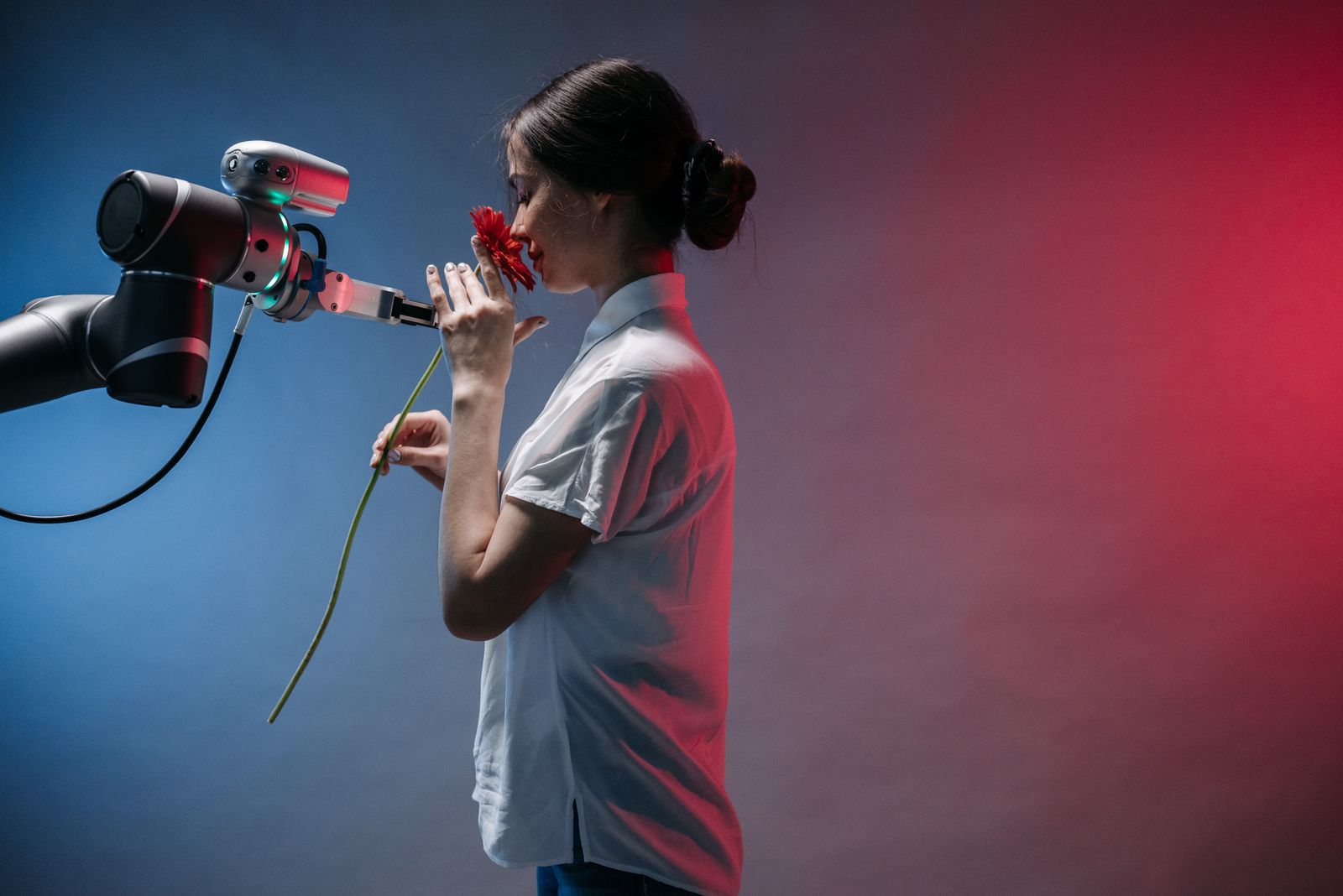
People already do, mostly with software. Millions of people talk to AI companions every day, and for some of them the relationship is romantic. At least one company already lists lifelike full-body humanoid robots, partly marketed for companionship, from 125,000 dollars. In his 2007 book Love and Sex with Robots, the artificial intelligence researcher David Levy predicted that people would be marrying robots by 2050. The prediction gets fewer laughs every year.
Researchers worry about three things. A partner designed by a company is designed to keep you paying. A partner who never disagrees can make ordinary human relationships feel harder than they need to. And children should not be in these relationships at all. China's rules for human-like AI companions, in force since July 2026, already ban offering minors virtual partners. The deeper argument about software partners, the ones on phones right now, is in our guide to the pros and cons of AI companions.
Why It Starts With Grandma
The companion robots doing the most serious work today are not in the homes of young technology fans. They are with older people who live alone, because that is where the need is sharpest, where families and governments are already paying for help, and where a patient presence in the house can ease a problem that is hard to solve any other way.
Calvin James Heath, who founded Goodbye App, sees exactly that path when he talks about where robot partners are heading:
I think they are great for the elderly, but as time goes on they will appeal to all ages. Grandmas will have a robot that cooks like Gordon Ramsay, sings like Elvis Presley and looks like Brad Pitt.
It is a joke with a serious prediction inside it: the robot will be shaped around the person, not the other way round, with the food she loves, the songs she grew up with and a face she enjoys looking at. That line even has a legal footnote. Tennessee's ELVIS Act, in force since July 2024, protects a person's voice as well as their likeness, and after someone dies those rights can be enforced by their estate or heirs. A robot that copied a real star's voice or a real actor's face without permission could break likeness laws like that one. The technology for imitating a real person has arrived well ahead of the manners, a problem our guide to AI versions of people after they die looks at closely. For what older people can use today, and what it costs, see whether robot companions are good for the elderly.
Then Everyone Else
Technology built for the people who need it most rarely stays with them. Television captions were made for viewers who are deaf or hard of hearing, and now many people who hear perfectly well switch them on. Once a robot is cheap, reliable and pleasant enough for a grandmother living alone, it is cheap, reliable and pleasant enough for everyone else.
- Children are likely to meet robots first as toys and tutors, and may treat them as a normal part of the room in a way their parents never quite will.
- Busy adults may buy a robot for the chores and keep it for the company, especially people living alone in cities.
- Families living far apart may use a robot as a body for a video call, one that can move around the house and follow a toddler into the next room.
- Teenagers are a group researchers and lawmakers are watching closely, because a companion that never judges can be most tempting exactly when friendships are hardest.
Will Robots Replace Human Relationships?
Probably not, but they will change them, and the likeliest change is quieter than a world of people marrying machines. It is a shift in what we expect from each other. If a machine is always available, always patient and always interested, then a friend who is late, a partner who is tired and a parent who repeats themselves may start to look like worse products.
The families who handle this well will probably use robots the way good families use television: as help, and sometimes as company, but never as the thing that decides whether anyone visits on Sunday. The robot can do the dishes. Somebody still has to sit at the table.
Full Circle: What No Robot Can Carry for You
Imagine the robot at its very best. It cooks your mother's soup exactly right, sings her favorite song, remembers every story she ever told it and sits with her in the evenings. It is still not her, and one day the family will stand in that kitchen without her, beside a machine that knows her recipes and has nothing of hers to say.
The robot knows what she did. It does not know what she meant. What she hoped for her grandchildren, what she forgave, what she wanted her son to hear on his wedding day: those words only exist if she says them herself, to the person they are meant for. A robot's memory, however detailed, was never addressed to anyone.
That is what Goodbye App is for. You say it yourself, in writing or in your own recorded voice, name the people it is for, and pick the moment it reaches them by email: a date up to thirty years away, or after you are gone. Until then no one else can read it, and you can still change it. It is free, and it works in thirteen languages. If you want to see how the ways of leaving a message compare, our guide to sending a message after you die sets them side by side.
Robots will make the future easier. Only you can make it personal.
Common Questions
Will humans have robots as partners in the future? As helpers, very likely, for people who can afford one. As companions, probably for many people, especially those who live alone. As romantic partners, probably for a small minority.
When will robots be in homes? Simple robots already are. The first humanoid home robots are on preorder, with deliveries promised but not yet confirmed. Morgan Stanley, for one, expects adoption to stay slow until the mid-2030s.
How much will a home humanoid robot cost? The first ones cost about as much as a car, or several hundred dollars a month on a subscription. Makers hope prices will fall as production grows, but nobody has proven that yet.
Can you fall in love with a robot? People can and do form real attachments to machines, and the feelings are genuine even though the machine's are not. Whether that is healthy depends on whether it adds to a life with people in it or replaces them.
Are home robots safe? Consumer humanoids are new and largely untested in ordinary homes. Keep them away from unsupervised children and frail people until there is a track record, and read the privacy terms as carefully as the safety ones.
What happens to a robot's memories when its owner dies? Often the company has not said. Replika's privacy policy does not mention the death of a user, and neither does the published NEO FAQ. Treat anything a robot or chatbot knows about you as held by the company, and put what you want your family to have into words addressed to them.
Every person has a legacy®
Begin